


©2023 Savvy360, LLC. All Rights Reserved
PLAN A TRIP IN OUR APP


Rina Mae Tabafunda

Rina Mae Tabafunda
Island Canvas
Hawai‘i Island’s creative community finds inspiration in ancestry, materials, and a deep sense of place
BY Sara Stover
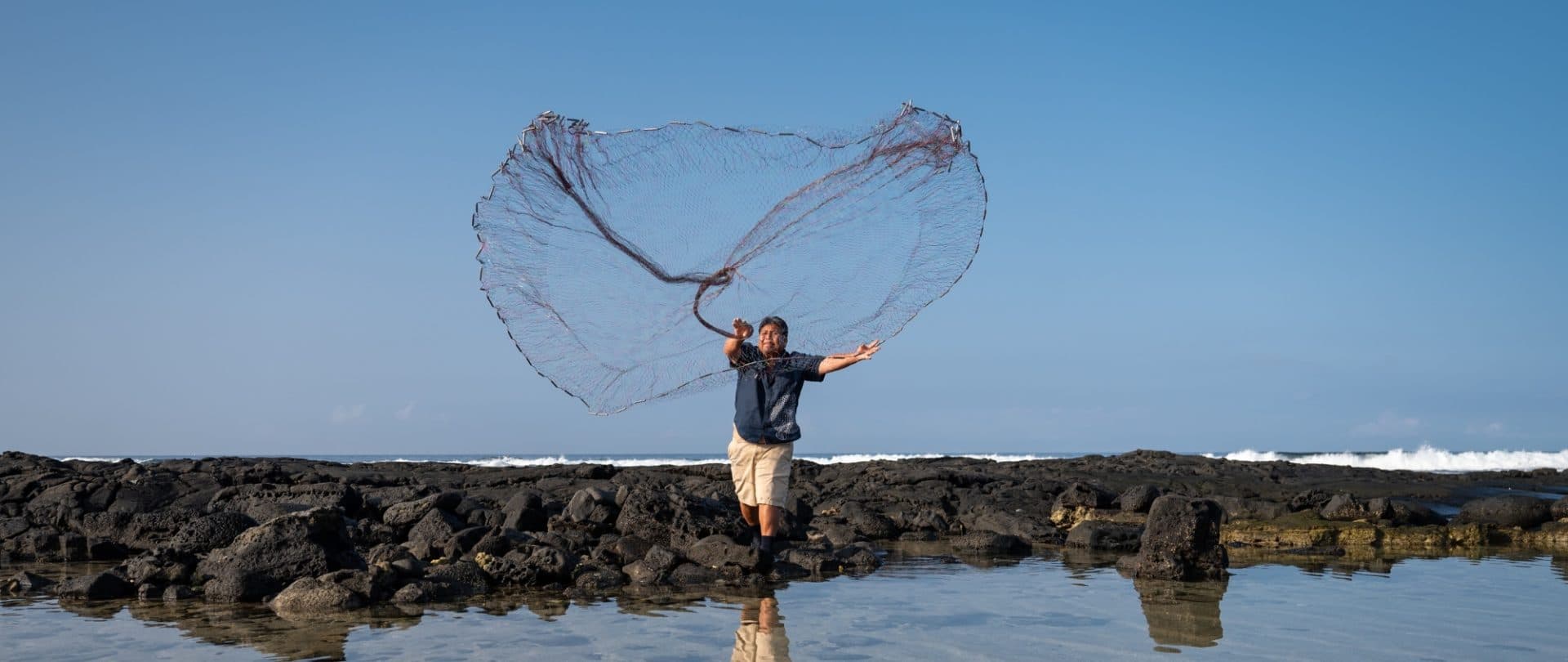
Apo Aquino carefully strips some bark off a kukui tree growing on the side of Hualālai Road. An ancient wind blows down from the mountain, ruffling the tree’s silvery-green leaves and whispering of a time when his ancestors traveled this same road.
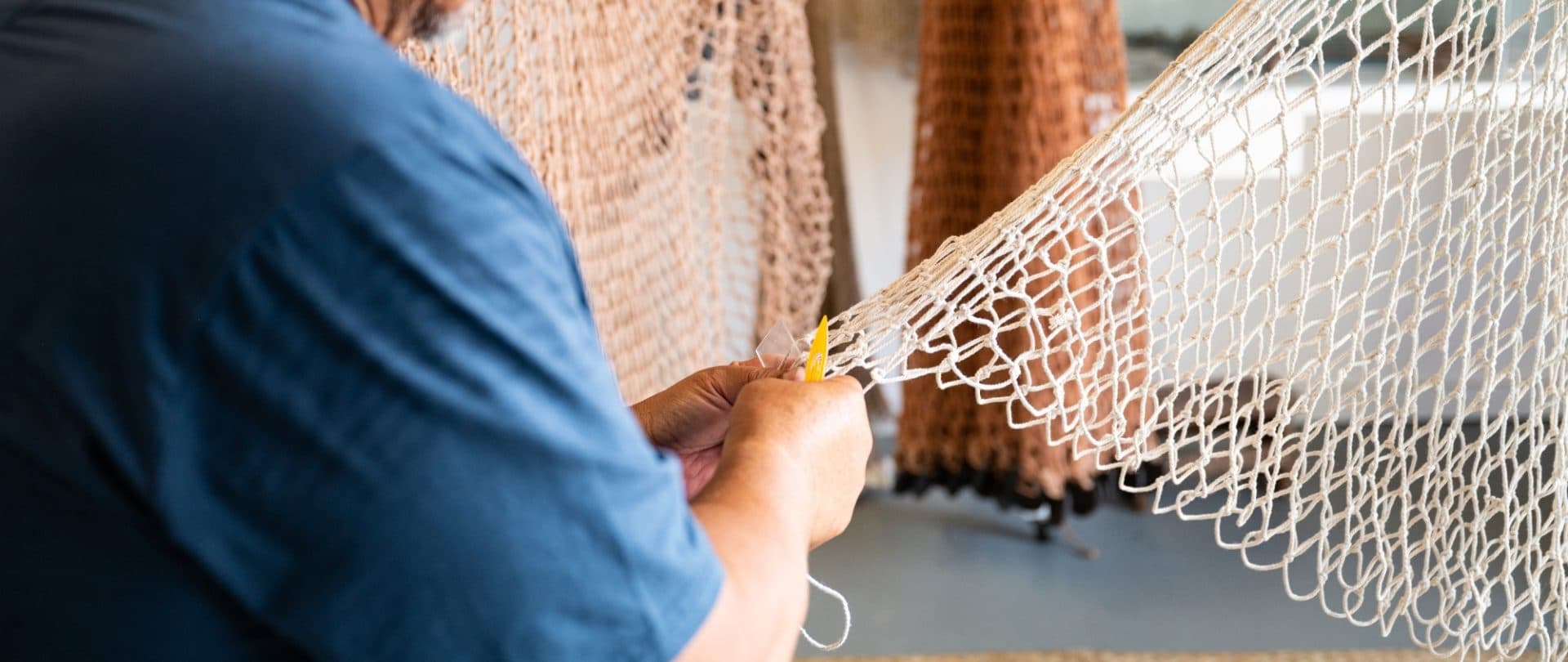
Apo is a Native Hawaiian fisherman, but lately, he has been spending more time gathering bark, leaves, bulbs, and shrubs for his handcrafted ‘upena (fishing nets) than actually fishing. From creating cordage using the bark of the hau tree and dyeing it with kukui or wild indigo picked from fields where his ancestors once dwelled, to weaving it into an actual ‘upena, every piece is made by hand and inspired by Apo’s ancestors.
“Fishing is always going to be within me, but now is a time for me to teach others how things were done in the past,” says Apo. “It’s in my blood to do this. My pieces represent my ancestry as a Hawaiian artist.”
Growing up in Kona, Apo has fished its deep, warm waters his entire life, just as his family has for generations. At a young age, he was taught to fish by his father and uncles.
“My father made the ‘upena. I couldn’t stay still, so I caught the fish. Years later, I wanted to get back into making nets, so I took out the one my father made for me and removed all of the lead from it. Then I hung it up, studied it, and made some nets like it for people to fish with.”
In Apo’s hands, this ancestral practice of weaving a practical ‘upena has become an art form. But that wasn’t his intention.
“One day, someone came into Kona Town Hui, the studio I have with my wife, and asked to buy a net I made … but not to fish with. He said, ‘A real Hawaiian made this net, and I’m going to show it as art in my home!’ That’s how this all started,” says Apo, who now weaves ʻupena to share his knowledge and talent in classes and art galleries to keep Hawaiian culture alive. “I brought my 8-foot, kukui-dyed ‘upena from Kona Town Hui and stretched it out in the lobby of the Mauna Lani, Auberge Collection, to make sure it looks right here. I also made an ‘upena I dyed blue using indigo.”
Around 1836, indigo was introduced to Hawai‘i and still grows wild in the ahupua‘a (traditional land division) of Kalaoa Makai, in Hawai‘i Island’s Kona District, where Apo collects it and uses the leaves for dye.
“I get to practice an art that is thousands of years old,” says Apo. “I hope my ancestors are proud that I am carrying on this tradition.”


Apo is one of several contemporary Hawai‘i artists whose connection to the island inspires them to share their craft. “There’s a generosity of spirit in Hawai‘i that runs through the artists and their works,” says Tiffany DeEtte Shafto, a storyteller, curator, and Hawai‘i artist herself. Over the past two decades, she has watched artists working across immensely different mediums and origins draw inspiration from the islands.
Shortly after Tiffany and her husband, Timothy Allan Shafto, relocated from the Bay Area to Hawai‘i in 2004, they felt a strong pull toward Hawaiian koa wood. Together, they transformed the tropical hardwood into jewelry boxes and furniture, using their hands to bring their designs to life. To be closer to the source of this endemic Hawaiian wood, the couple moved from Kaua‘i to Hawai‘i Island in 2007 and joined the thriving Hawai‘i Wood Guild.
The welcoming community inspired Tiffany to document the works and stories of Hawai‘i’s award-winning woodworkers through her book, Contemporary Hawai‘i Woodworkers: the Wood, the Art, the Aloha.
“That book led me to a research project looking at the economic and social impact of Hawai‘i Island artists on behalf of a grant I wrote for Volcano Art Center. I met over 500 island artists, including Kathy Long and her husband Bertil,” says Tiffany. “They invited Tim and me to participate in a pop-up art event at the Four Seasons Resort Hualālai, which evolved into a full-time, artist-run gallery.”
It was here that Tiffany witnessed Timothy’s drive to create.
“When the waves of inspiration wash over him, he can’t ignore the ideas. Once they are given to him, he must find a way to bring them to life. So when the opportunity at Hualālai ended in 2014, I told Tim to keep going in his new direction,” Tiffany recalls. “We support one another’s dreams and do our best to help bring them to life. Tim is the one who encouraged me to follow my calling, helping people create beautiful environments with local art by opening a gallery more than a decade ago.”
“My mixed-media paintings began around the same time because I wanted to honor the beauty of Hawaiian koa wood in a new way,” says Timothy, an award-winning woodworker who combines koa with “colorflow” abstract mixed-media painting, mounted in integral wood frames. “Endemic to the islands and found nowhere else in the world, koa has become scarcer over the past 20 years, salvaged only from dead, fallen, and dying trees.”
“Hawai‘i is rich with local artists like Tim, inspired by this incredible environment and all its stories and connections — and I’ve had a front-row seat,” says Tiffany, who has a by-appointment private gallery in Hāwī, Tiffany’s Art Agency, where she serves as a bridge between the collector community and Hawai‘i’s community of visual artists.
Uruguayan-born Valeria Mastrascusa wasn’t even 5 years old when her grandmother began teaching her both the art of painting and the sacred meanings of all arts. This kindled a passion that burned brighter as Valeria shadowed artists in Uruguay, studied graphic design, and worked in the fashion industry.
“Twenty years ago, I moved to Miami and got away from my own art. Then I moved to Hawai‘i seven years ago, and my sister suggested that I paint again. There must have been something in the air, because once I started, I couldn’t stop. There’s a creative energy here that makes me feel the need to paint every day,” says Valeria.
Valeria captures the transcendent beauty and mana (spiritual energy) she sees in the natural world through oil paintings that primarily depict seascapes, sunsets, and ephemeral moments when water and sky blend.
“I take tons of photos at the beach of the light coming through the waves or sunset. Sometimes I’m there with my family, and my nephews might be running around, having fun, but it’s calm at the same time. Then I grab my brush when I get home and try to translate it all — the movement and stillness, the colors and light and shadows, and how everything made me feel,” Valeria says.
“From the ocean to the sunset, I see a wider range of colors here in Hawai‘i. In my mind, they combine into the blues and greens of the waves and the trees’ leaves that I paint. That’s where I see my grandmother's influence,” says Valeria, whose rich creative heritage has merged with her experience in Hawai‘i, influencing the colors and styles she chooses. “Oranges and reds have also been resonating with me lately. That’s the influence of Hawai‘i and its sunsets.”


Award-winning surfer Christian Enns’ oil painting of Hāpuna Beach is missing something, and it’s not color.
“My art speaks to the positivity I feel across Hawai‘i Island. You can see the light and color of these inspiring places, like Hāpuna. But sometimes I leave out the infrastructure to focus on how Hawai‘i was before all the development,” says Christian, who has studied art in over 30 countries. “For the past 20 years, Hawai‘i has been the center of my universe, shaping my craftsmanship and philosophy as an artist. The island is growing and living, which gives me the confidence to express myself through bold colors and big pieces.”
Christian’s work is a direct response to the profound connection he feels to the world around him in moments when a golden sunrise sets wet leaves ablaze with its glow or his ancestors send him the perfect wave to catch. As he looks to shore, the sense that those he has lost are looking over him — his grandfather, parents, and brother — and the richness of Hawai‘i’s landscapes from the water often move him to paint plein air back at the water’s edge.
“I use my works to translate the islands’ light, energy, and spiritual resonance into oil paintings that move between representational and imagination,” Christian says. After using preliminary drawings and smaller studies to uncover the foundational elements and colors that will define a piece, he constructs his own panels and canvases. Christian then establishes a composition through line drawing before employing an underpainting technique to reveal the emerging image and painting alla prima, a wet-on-wet technique that uses thick oil paint.
Drawing inspiration from the curves of surfboards, Christian also elevates koa and other exotic woods into large-scale sculptures that embody both the spirit of surfing, with deep roots in Hawai‘i, and the beauty of nature.
“In May 2026, I won the Hawai‘i State Surfing Championship riding my own hand-crafted shape,” Christian shares. “In that moment, decades of surfing, craftsmanship, and artistic dedication united into a single achievement.”
To see Hilo artist Kristie Fujiyama Kosmides’ piece Serenity & Strength, you’d never guess that she once struggled with painting water elements, as the oil painting embodies the energy of the ocean. While painting a large piece commissioned by Honolulu’s Daniel K. Inouye International Airport years earlier, however, she decided it was a study she needed to master. For five years, Kristie only painted water, finally moving on to a five-panel oil painting commissioned by the Hilo International Airport.
Her friend, videographer Tracey Niimi, introduced Kristie to ‘ukulele virtuoso Jake Shimabukuro in 2020, and the three began a cross-disciplinary collaboration for the airport called Eyes of the I‘iwi. While Kristie painted, Jake penned a song of the same name and even painted some of the under layers of the piece, and Tracey captured the experience on video. That collaboration inspired Jake to pick up a paintbrush and lose himself in his second piece, Perseverance, which is a display of vivid colors moving across the canvas.
Kristie, who has shifted into abstract painting, has also launched Abstract Collab with Jake. The two artists bring 10 people into the studio to an immersive, unrehearsed world where creative energy is unleashed. Some guests join Kristie in expressing themselves on a massive canvas, and others stomp pedals to adapt the sound of the music Jake creates. Once completed, every work of art is preserved and added to the Abstract Collab Collection, creating a growing body of work to be shared with the island community.
“One day, the 19-year-old son of some wonderful collectors approached me after a 15-minute conversation with Jake, saying, ‘I get art now! I hear it!’” says Tiffany. “I realized that for some people, color has certain sounds and helps them understand and feel abstract work. It’s amazing!”
Waimea-based visual artist Margo Ray was on a hike in the pristine forest of the Kohala Watershed when the contrast of the blooming Native Hawaiian ‘ōhi‘a lehua along the dry, abandoned ditch moved her to stop and take some photographs. The images became the inspiration for her piece All the Tears I Have Yet to Cry, Kohala Ditch, part of a series focusing on the relationship between man-made infrastructure and nature.
“The ‘ōhi‘a lehua are a critical plant to our Hawaiian forests and watershed, but they’re in danger due to disease and invasive species. This work is an homage to them,” Margo says of the eye-catching, mixed-media piece featuring ‘ōhi‘a lehua blossoms kissing a pastel sky.
"Being born on O‘ahu and raised on Hawai‘i Island has given me a heightened awareness of both solitude and connection, which shapes my work. In my paintings and collages, I weave imagery of rural infrastructure that communicates this solitude into layered landscapes that explore the interplay of natural, spiritual, and built environments,” says Margo, whose iconography draws from the landscapes of Hawai‘i and Japan, where she lives part-time, filtered through her energetic and spiritual interpretations of place.
Margo is also creating a research-driven series to highlight the pathways and waterways at Mauna Lani, featuring the traditional Hawaiian Lāhuipua‘a and Ka‘ai‘ōpio fishponds and the mākāhā (sluice gates that regulate fish flow) found on the resort’s grounds.
“It is rare to find spaces on the island with large, white walls like those at the resort,” Margo points out. “Since my work is detailed, colorful, and done on a large scale, this environment allows viewers to fully appreciate it without visual distraction.”
At the heart of the 34-acre oceanfront Mauna Lani, Auberge Collection property is Kalāhuipua‘a, an area of approximately 15 acres that includes the six ancient, ocean-fed fishponds inspiring Margo’s research-driven series. For centuries, Kalāhuipua‘a was a sacred site, a summer home for Hawaiian royalty, and a fabled retreat. Here, Kamehameha the Great mastered the art of aquaculture in the fishponds, and former landowner Francis H. I‘i Brown connected with his Hawaiian ancestry at the Eva Parker Woods Cottage, a 19th-century home built on land originally owned by the Parker family that still sits on the resort’s grounds.
Today, individuals rooted in a quest for mastery of their own art are represented across open spaces throughout the hotel. Meaning, “mountain reaching heaven,” Mauna Lani is a giant, blank canvas for an array of aesthetics and media.
“Hawai‘i is rich with people who value local art and how it makes them feel in their homes and businesses — connected, inspired, uplifted — but it can be hard to find. So, I’m creating a large, living art gallery in collaboration with Mauna Lani, where many of the voices from our artistic community come into conversation,” says Tiffany, who is painstakingly curating artwork inspired by the colors, textures, and vibe of Hawai‘i that complements the resort’s legacy. “I’m transforming unadorned walls throughout the resort into pockets of discovery, creating a sense of wonder for the viewers with works that resonate together, inspired by the ocean, ‘āina (land), and sky.”
Art enthusiasts can enjoy a self-guided art walk through the gallery, discovering an ever-rotating collection of original works by local artists from across the state of Hawai‘i. Art inspired by the energy of the ocean accentuates the first floor. Surf aesthetics are at home on the fourth and fifth floors, where artwork moves viewers from the ocean to land. On the sixth floor, Tiffany has chosen to lean toward the abstract, taking us up above the palm trees and out into a land of ethereal dreaming.
Some areas around the walkways are untouched by artwork, however, and with good reason: “I want to honor the natural beauty of this place by not being overly busy,” Tiffany says.
“Our partnership with Tiffany’s Art Agency gives us the opportunity to honor Hawai‘i’s vibrant creative community in a truly meaningful way,” adds General Manager of Mauna Lani, Auberge Collection, Pete Alles. “By providing a space for local artists to share their work, we invite guests to experience the spirit and beauty of the islands through their eyes at Mauna Lani.”
Sea glass, black sand beaches, and rip currents pull you into the fourth floor of the Mauna Lani, where painter and printmaker Mary Spears uses hand-painted paper to create captivating texture and exaggerated movement reminiscent of block printing, painting, mosaic, and the ocean itself. Inspired by the mosaics of Pompeii, Mary uses the color and playfulness of tiny pieces of torn paper, assembled into tropical fine-art collages, to evoke a feeling of whimsy.
Inspired by gyotaku, the traditional Japanese art of fish printing, Mark Ley dips fins and surfboards he finds while scouring Hawai‘i Island’s beaches and reefs into acrylic paint and then presses them onto paper. Pieces like Au Moana, which is on display in Mauna Lani’s upper lobby, memorialize abandoned boards and the ocean explorers they once belonged to.
As guests come and go from Mauna Lani, they pass two of Apo’s ‘upena, intentionally selected to frame the entry. Inspired by the beauty of the blue ocean, Polū ‘Ekolu’s netting is made with cotton cordage and tied together with many knots. Representing Apo’s first large cordage art piece made outside of the functional ‘upena style, Kukui ‘Ekahi (which means “one”) is made with kukui-dyed cotton cordage.
“Artists are always documenting a time and place in their work through the use of an array of materials, styles, and colors,” Tiffany says. “In Hawai‘i, this includes talented ‘upena weavers, painters, and woodworkers. Being able to show Apo’s traditional knowledge through the art of his hand-woven fishnets on the walls of Mauna Lani feels like just the right connection to weave their shared inspiration together.”
Tiffany’s Art Agency, Hāwī; by appointment; tiffanysartagency.com. The self-guided art walk is open to guests of the Mauna Lani, Auberge Collection.