


©2023 Savvy360, LLC. All Rights Reserved
PLAN A TRIP IN OUR APP


Sacred Realm
Explore the storied trails of Makāula-‘O‘oma, a place where nature and culture converge.
BY Sara Stover
Perched above Kona’s sun-drenched coast is the Makāula-‘O‘oma Tract, a significant area of protected native cloud forest within the Honua‘ula Forest Reserve on Hualālai Mountain’s western slopes. Just under a 30-minute drive from the historic Kailua Village, the cooler temperatures provide a refreshing escape from Kona’s heat, beaches, and bustle.
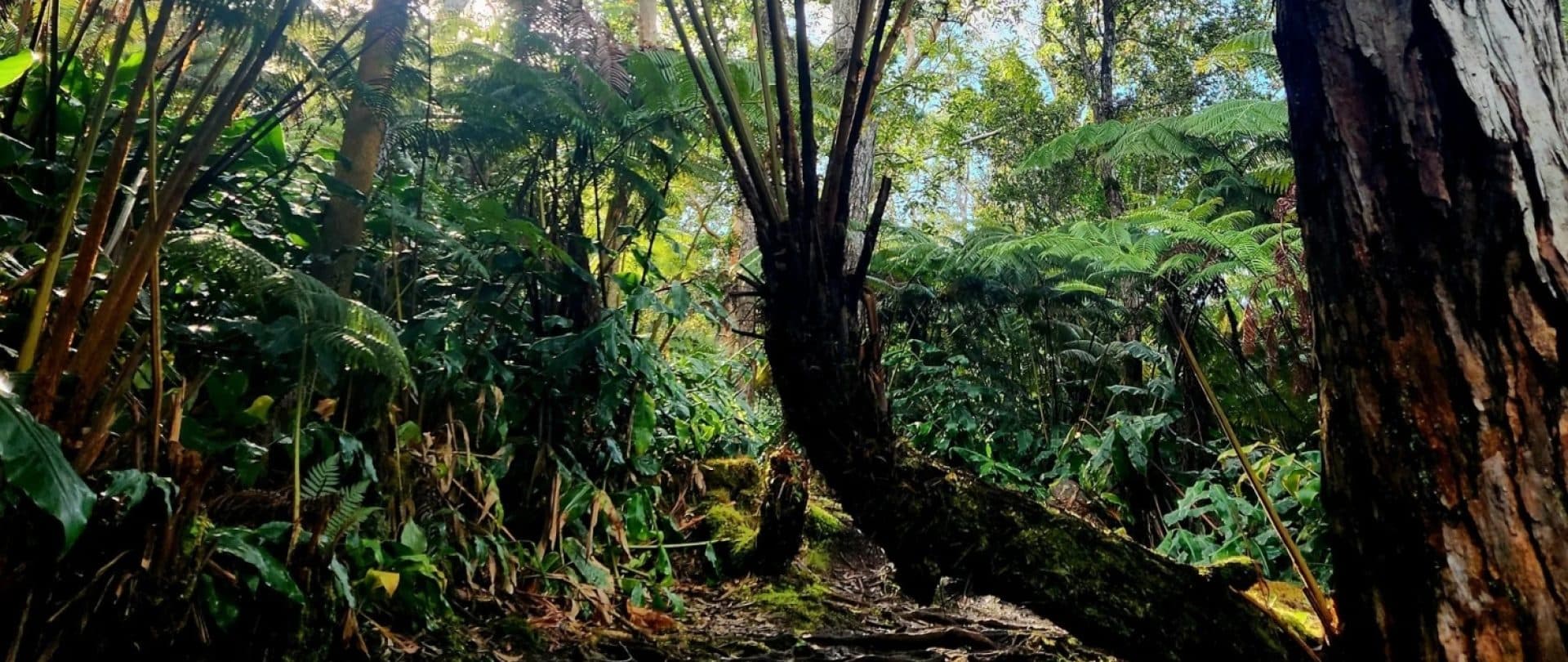
Unlike warmer rainforests, which are found at lower elevations and receive more direct rainfall, cooler cloud forests are found at higher elevations where damp ocean air rises to meet the mountain and condenses into low-level clouds that consistently envelop the forest. With elevations ranging from 2,759 to 3,432 feet, the cloud forest at Makāula-‘O‘oma is an essential ecosystem for endemic and native birds and plants. And you can explore its lush vegetation of ferns and trees through a network of primordial trails created more than 30 years ago.
In the mid-1990s, the State of Hawai‘i reclaimed lease portions of land from Huehue Ranch to establish forest reserves for recreation in Kona. The 1,365-acre Makāula-‘O‘oma section within the Honua‘ula Forest Reserve is located on the northern boundary of the Kaloko subdivision and was designated for hiking and mountain biking. In 1993, the Department of Forestry and Wildlife (DOFAW) recruited Dr. Jeff McDevitt and Grant Miller to design and build trails for the reserve. Over the following years, McDevitt, Miller, and volunteer crews used hand tools to construct approximately six miles of trails. Today, the trails are maintained by West Hawaii Trails, a 501(c)(3) nonprofit run by Dr. Jeff McDevitt, along with volunteers from PATH (Peoples Advocacy for Trails Hawai‘i).
Although the morning can be chilly, it’s the ideal time for a hike on Makāula-‘O‘oma’s forest trails. Mornings tend to be drier, with blue skies peeking out above the treetops. No matter when you visit Makāula-‘O‘oma, be prepared to explore a wildland area with no facilities. Bring drinking water and, if needed, a rain jacket and wear sturdy shoes that can handle varying terrain.
The trailhead is accessible by taking Highway 190 to Kaloko Drive, between the 34- and 35-mile markers. The drive up Kaloko is scenic, with palm trees, monstera, anthurium, rainbow eucalyptus, and bamboo all lining the steep road. After about four miles, Makahi Street will be on the left. Park near the trailhead sign at the end of the road.
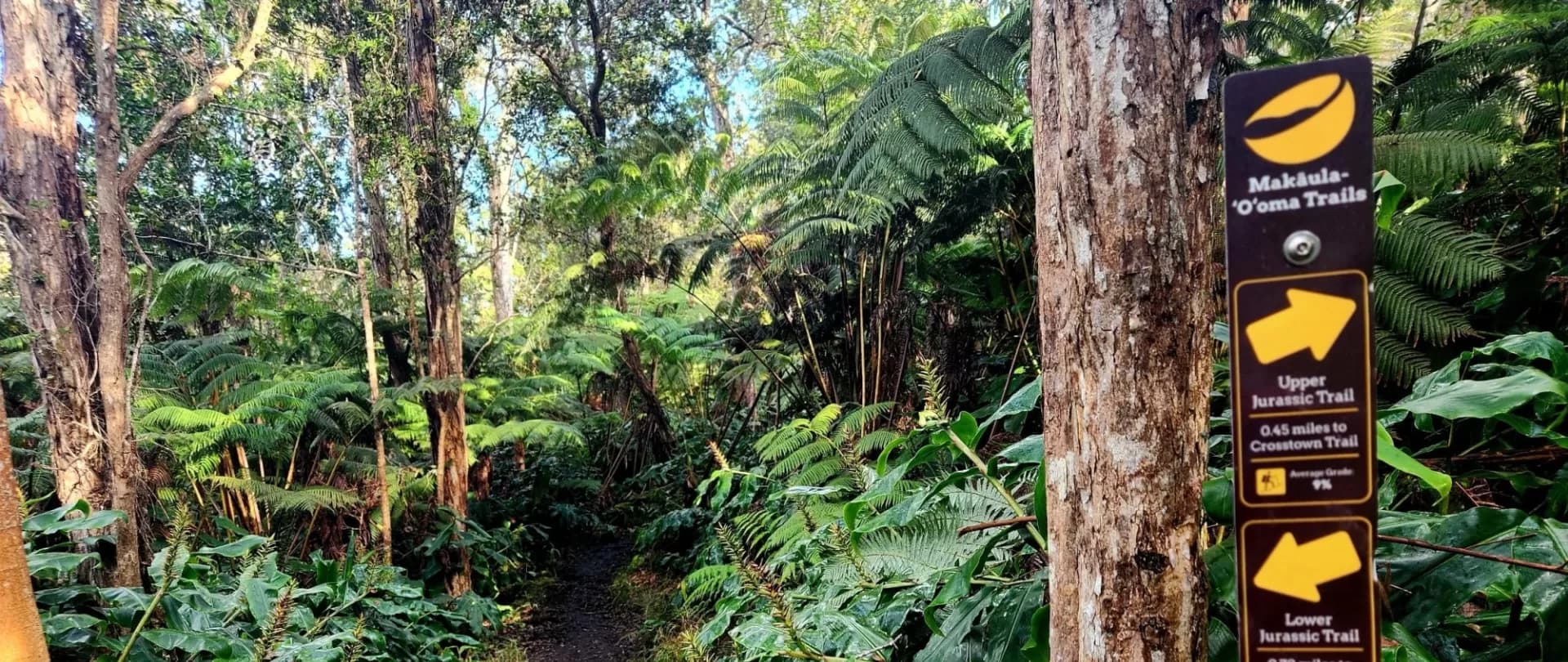
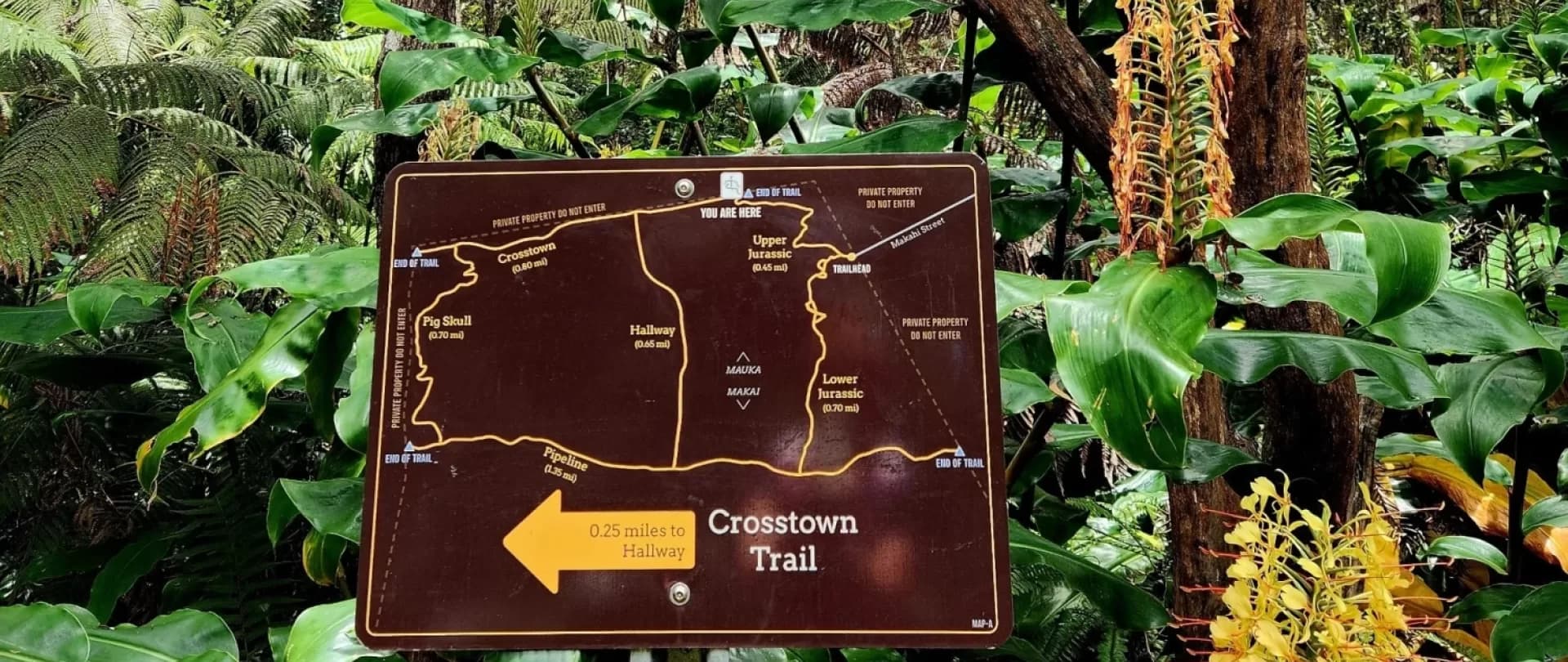
Stop at the trailhead sign to learn more about the cultural and ecological significance of Makāula-‘O‘oma and familiarize yourself with the trails. To prevent the spread of invasive plant seeds and diseases that threaten the forest’s fragile ecosystem, clean off your shoes at the brush station before and after hitting the trail. Let the sound of chirping crickets and the cool of the forest wash over you as you choose between Upper Jurassic and Lower Jurassic, two aptly named, unpaved trails. On both, you may encounter loose rocks, roots, wet leaves, and mud that encourage you to slow down and enjoy the tranquility and greenery.
The reserve is located at the top portion of the ahupuaʻa (traditional land division) of Makāula and ‘O‘oma. Travel back in time through the ahupua‘a’s uplands, which were once considered the wao akua, a realm of the gods so sacred that only certain community members could enter. Here, trees were regarded as a physical manifestation of the spirit realm.
It is said that this area is named after the makāula Moemoe, a prophet with the power to see the future. Moemoe was famous for his speed as a runner, as well as for protecting the people of Kekaha Wai ‘Ole (the dry, coastal lands of the Kona district) from
Iwaha‘onou, a shapeshifter who often took the form of a shark. Today, the Makāula-‘O‘oma trails attract skilled runners who want to test their own speed. Most visitors, however, prefer a leisurely hike over rushing through the forest.
If you're looking for a shorter hike, turn right from the trailhead onto Upper Jurassic for an out-and-back adventure. The reserve is surrounded by private property, and beyond the trails, there can be steep drops and loose rocks. Stay on marked trails to avoid trespassing and remain safe.
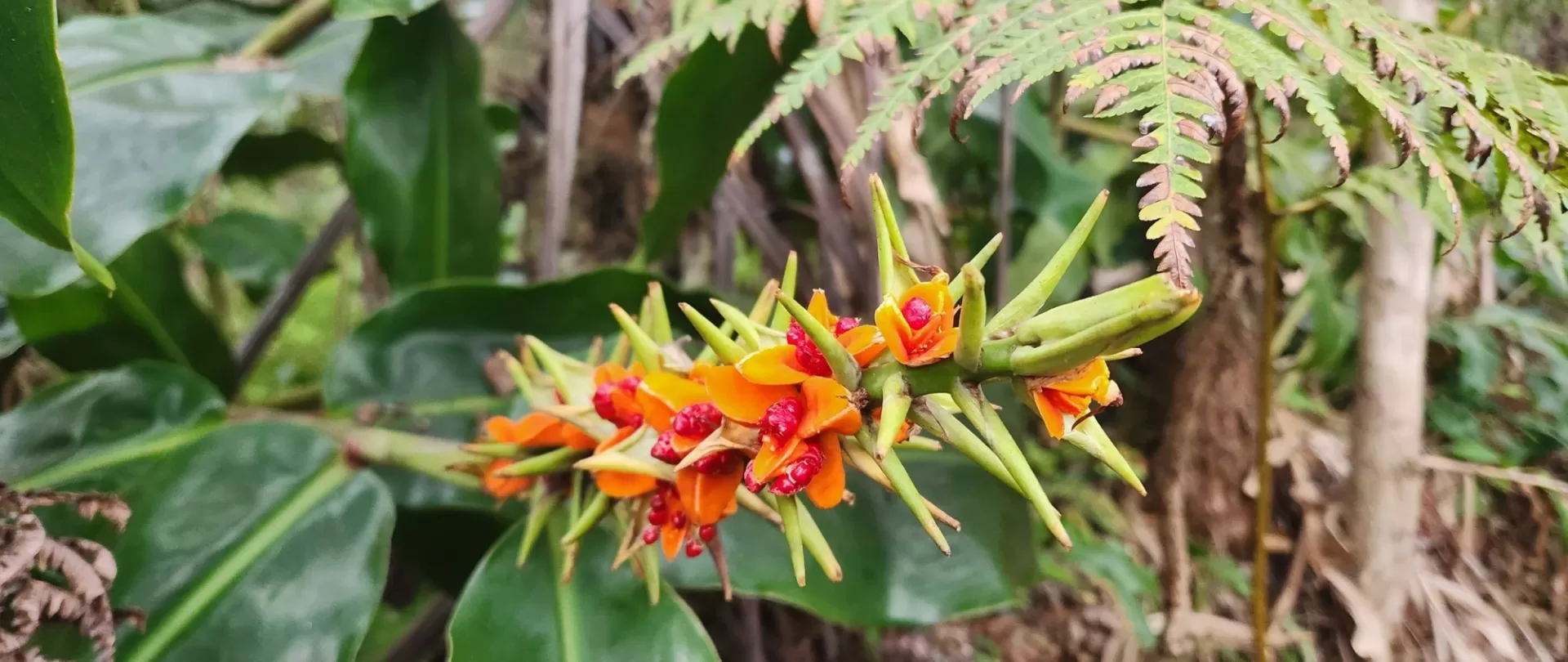
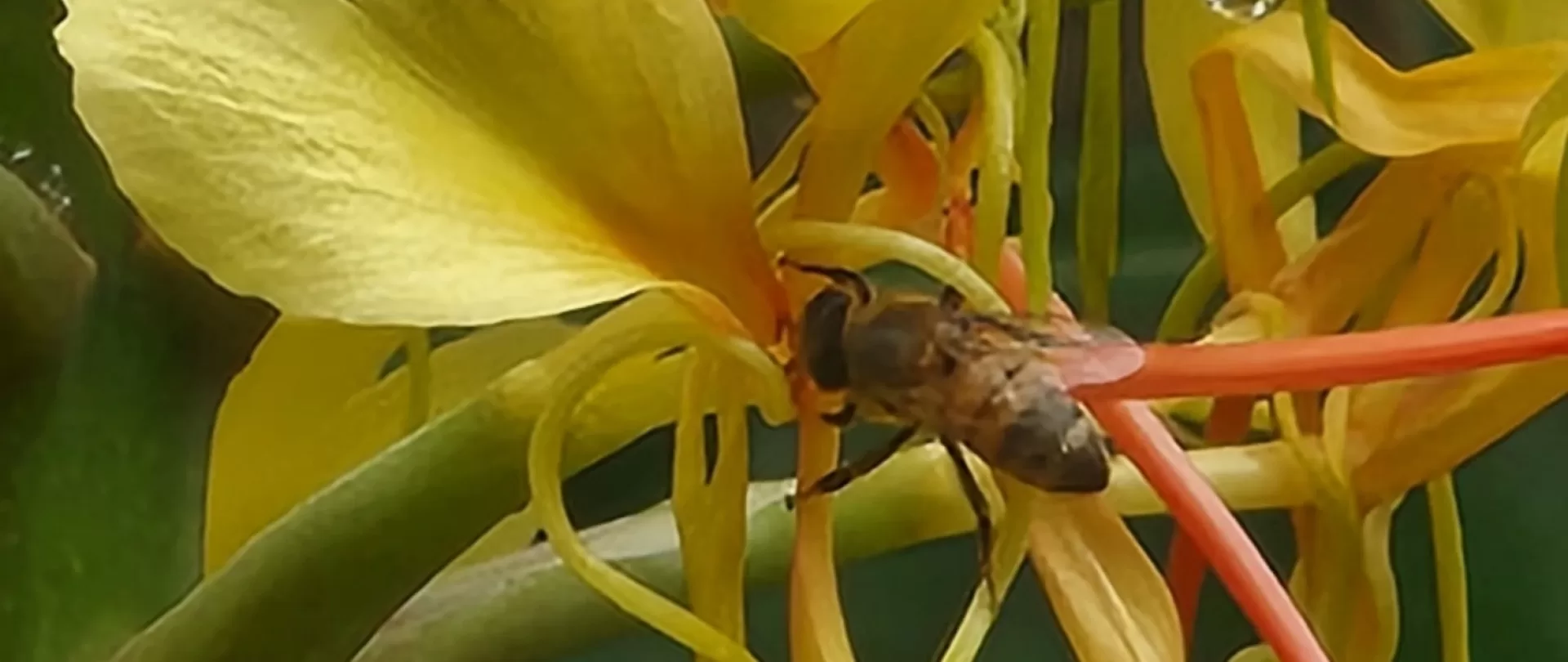
As you ascend through the reserve, you’ll cross two natural bridges leading you deeper into ancient forests and past kahili ginger. Although invasive in Hawaiʻi, the ginger’s golden flowers scent the trail with their enticing fragrance when in bloom. After 0.45 miles, you’ll reach the Crosstown Trail. You can turn around here, continue another 0.25 miles to Hallway, or traverse all 0.8 miles of Crosstown and turn around once you reach Pig Skull Trail. Whatever distance you choose, you’ll gain a deeper understanding of the importance of this enchanting cloud forest. The forest was a vital source of resources for the traditional Hawaiian way of life, including wood and plants for practical, medicinal, and spiritual purposes.
As you hike, you may notice dewy moss growing on towering koa trees, the leather leaves and smooth bark of the ho‘awa tree, and the glossy green leaves of the Kōlea lau nui tree. Hawaiians used the wood of these trees for crafting tools, shelter, and pale (gunwales) for canoes. The bark of the Kōlea lau nui tree was also used for creating dye.
If you’re interested in exploring more of the forest reserve, turn left onto Hallway. As you descend, you may be treated to the ethereal sight of low, misty clouds rolling in or trees that have shed their leaves. As a seasonally dry cloud forest, Makāula-‘O‘oma receives substantial moisture from low-level clouds and fog but has a distinct dry season. As a result, the forest reserve’s flora is uniquely adapted to the extreme conditions, and some plants drop their leaves during the dry season.
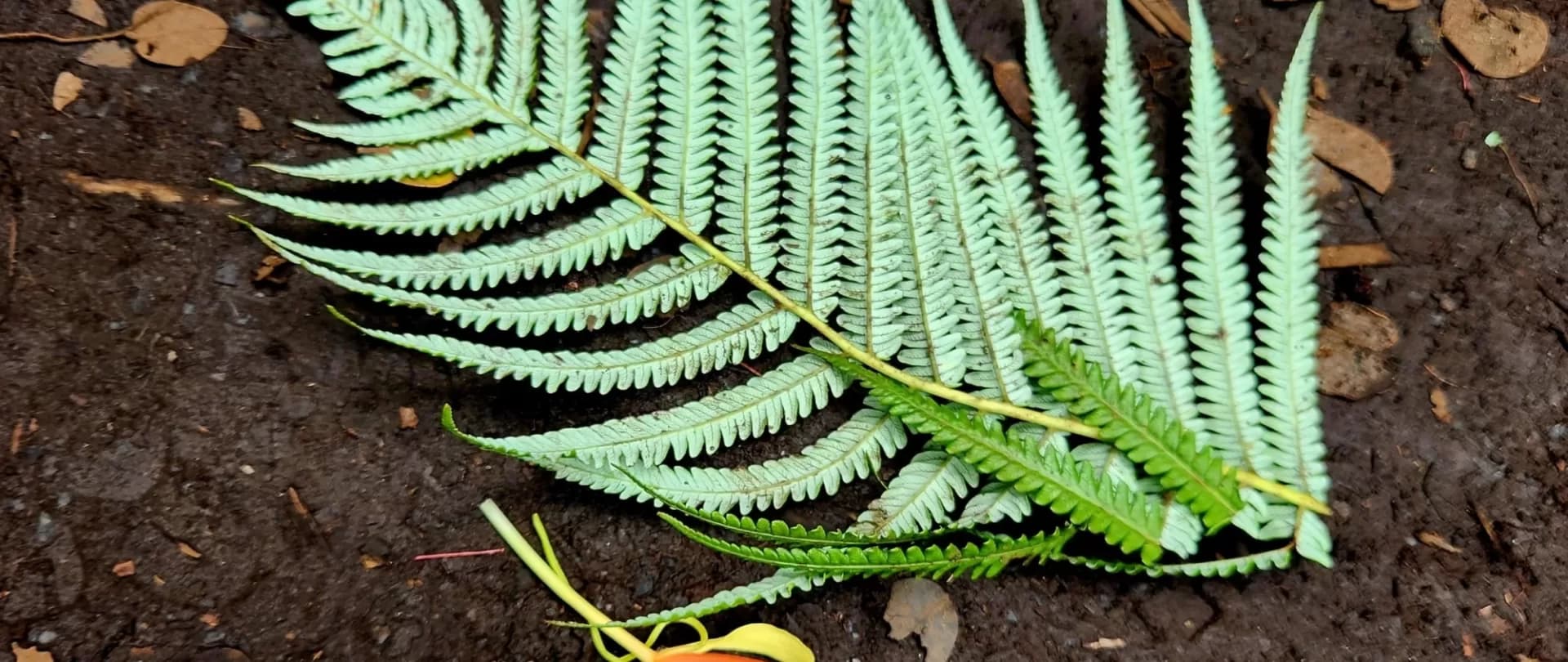
Turn left when you reach Pipeline, which will eventually intersect with the Lower Jurassic Trail. As you climb up Lower Jurassic back to the trailhead, you’ll pass under canopies of Hāpuʻu tree ferns. Hawaiians found many uses for the Hāpuʻu, including treating wounds with its pulu (soft fibers).
If you have the time to challenge yourself by hiking an entire four-mile loop, start at the trailhead and take Lower Jurassic, turning right on Pipeline, climbing up the Pig Skull Trail, and turning right on Crosstown before beginning your final descent down Upper Jurassic. No matter which loops you choose, keep an eye out for the ‘elepaio (Hawaiian flycatcher), which can be seen catching winged insects, and the ‘io (Hawaiian hawk) as it soars out of the shroud of clouds to prey upon smaller birds and rodents. Listen for the call of Hawaiian honeycreepers like the crimson red ʻapapane and the sunny yellow ʻamakihi as they dart from branch to branch, feeding on the nectar from flowers and foraging for insects from tree bark.
Hear the echo of the ʻi‘iwi bird’s song from the boughs and blossoms of the ʻōhiʻa lehua tree. While the ʻōhiʻa has been threatened by disease in recent years, the ʻiʻiwi helps maintain the tree’s resilience through its crucial role as a pollinator. As an endangered Hawaiian honeycreeper, the ʻiʻiwi relies on the ʻōhiʻa for habitat and food. Its curved, long beak is even adapted to feed on the nectar the tree provides.
Those who step onto the trail of Makāula-‘O‘oma with an open heart and stop to look up into the treetops can witness symbiotic relationships among the endemic and native plants and birds, making it clear that what was once an ancient wao akua remains a sacred realm to be protected and treasured.