


©2023 Savvy360, LLC. All Rights Reserved
PLAN A TRIP IN OUR APP





The Art of Becoming
Inside the bold landscapes of Lindsay Gilmore
BY Donna Britt
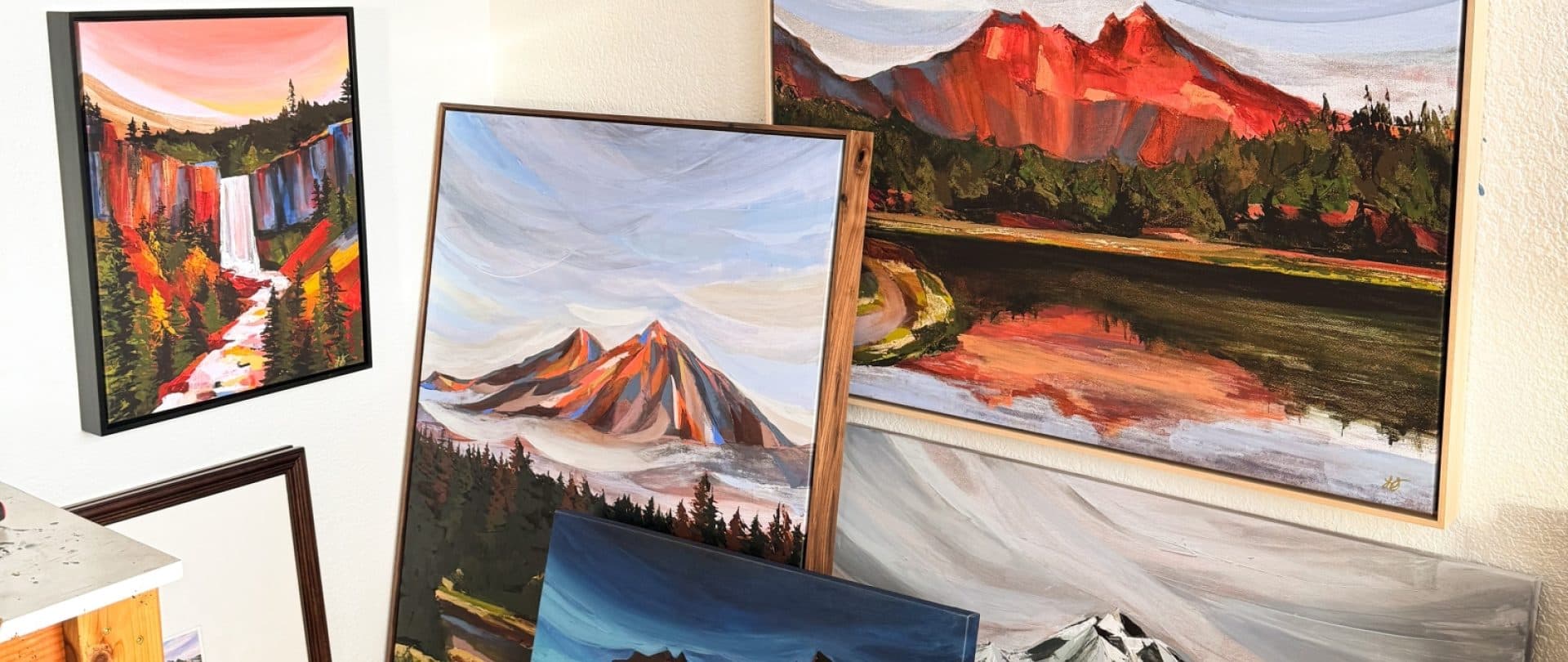
The light pours through the second-floor windows of The Stacks in the Old Mill, catching on brushes, tubes of paint, and colorful splatters. From her studio overlooking the Deschutes River and the distant snowcaps of the Cascades, Lindsay Gilmore works in color — bold, unapologetic, full-of-heart color. It is the kind of color that makes you feel the place, not just see it. “I think I’m trying to capture that feeling of being ‘in’ a place,” she says, when asked how she would describe her own paintings. “Where you’re really immersed, like you’re really there experiencing it versus seeing a picture of a place.” Gilmore’s work is both rooted and otherworldly, abstract and emotional, a map of her connection to nature and the life she has built in Bend with her husband, Beau, and their two young daughters.
From Ad Agency to Artist
Growing up in Atlanta, art was always the thing that came easily to her. “I had to try really hard to be mediocre at sports,” she laughs, “but art was a natural thing for me.” Teachers encouraged her early, telling her she had a gift, and she believed them just enough to keep at it. But when it came time for college at the University of Georgia, she took what she thought was the responsible route, double-majoring in marketing and advertising instead of art. “I was told you can’t make a living doing art,” she says. “So, I thought, okay, maybe I can do something creative, but more practical.”
That led to a job at a creative agency in Virginia, where she did everything from answering phones to managing client accounts. Eventually, she convinced her bosses to let her do a little design work. “I kind of snuck my way in,” she says, and found herself on the other side of the table, learning visual composition on the fly. Before long, the portraits started. Co-workers began asking her to paint their babies and dogs. She started doing realistic watercolor and ink portraits on commission. “It was very much on the side at first,” she adds. But life has a way of nudging artists toward what is inevitable.
Finding Her Voice in the Landscape
When Lindsay and Beau moved to Portland, she dove deeper into portraiture, building a business drawing and painting commissioned portraits. It was rewarding at first, then it became exhausting. “There’s no passive income in portraits,” she says. “You can’t sell a print of someone else’s dog.” Then she became a mother, and everything shifted. “I was totally burnt out,” she recalls. “I stopped cold turkey. I wanted to make work that I felt passionate about.”
The answer was obvious: landscapes. “We spend so much time outside. That’s where I find peace, where I refill my cup,” she says. “So, I decided to paint landscapes since that’s what I wanted to hang on my own wall.” She decided to paint twelve landscapes, just for herself, and share them online. “I thought I’d be thrilled to sell even one,” she laughs. “They sold out the first day.” That first sold-out collection changed everything. “It was thrilling,” she says. “People resonated with the work, and I could tell it had room to grow. I was painting something I was connected to. That was huge.”
Art That’s Accessible and Joyful
From there, Gilmore began releasing small, themed collections — twelve to fifteen paintings at a time — and they started flying off her website. Her vibrant, knife-textured acrylics captured something people recognized from their own time outdoors: the emotion of being there.
Even as her originals rose in value, she stayed committed to accessibility. “If you resonate with the work, I want you to have it,” she says. “So I make stickers for four dollars, greeting cards for six, prints for thirty.” She also does embellished prints, in which she paints directly over a print to replicate the look and feel of an original painting at a lower cost than an original. Again, providing even more accessibility to her art.
When the family moved to Bend in 2020, the business side of her art took off. She had an opportunity and needed to figure out how to make prints. She got connected with a local printer who apprenticed under the famously luminous Thomas Kinkade, who helped her produce high-quality prints. He is still her printer and now not only produces prints but also puzzles, stickers, and other products showcasing her artwork. That passive income became the foundation that allowed her to focus more on painting. “It was the first time it felt like a real job,” she says. “I never thought it would be possible, but turns out, it is.”
Owning the Title
For years, Gilmore worked from home, “in my daughters’ playroom,” she says, until a friend’s husband, who handled leasing for the Old Mill District, offered her a studio space. She turned him down at first. “I thought, why pay for something when it’s working fine?” she says. “But he convinced me that my business would grow if I took myself seriously.” She took the leap and never looked back. That was over three years ago. Now, when you walk into The Stacks Art Studios & Gallery, you’ll find her surrounded by canvases in progress, chatting easily with locals, tourists, and kids. “The best thing about having the studio is that it made me take myself seriously,” she says. “And it’s so cool for people to see the art in person, to meet me and the other artists. There’s a kind of magic in that connection.”
Letting Go of Perfection
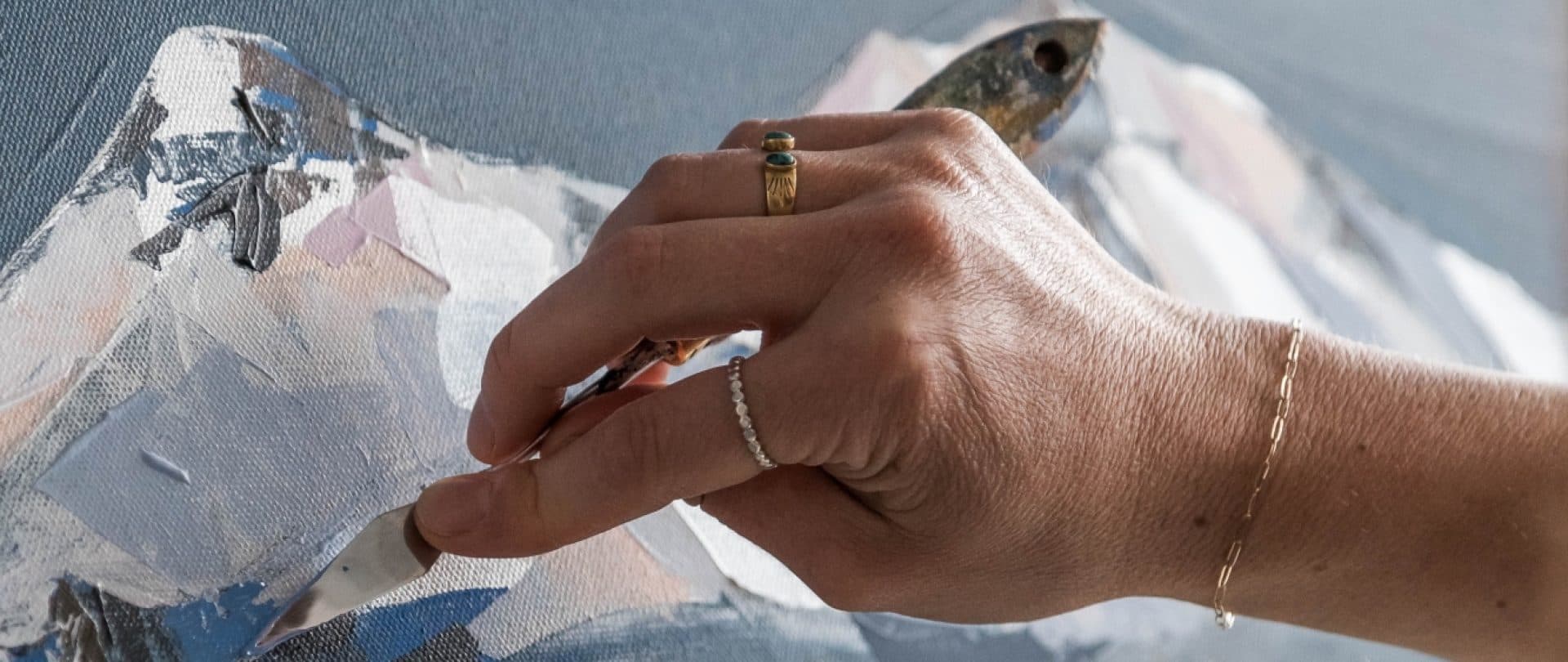
Gilmore primarily works with a palette knife, a tool that has become part of her artistic identity. “My high school art teacher always told me I was too Type A,” she says, smiling. “He said I needed to loosen up. You can’t be too tight when you’re painting with a knife. It forces you to let go.” That looseness translates into texture and movement that give her paintings a visceral life. They are not about representation; they are about feeling. And while she is plenty organized in her personal life, it is in her paintings that she lets go of control. “When I paint, I’m crazy and can release this other side of myself,” she says.
Freedom to Choose
In her ongoing quest to protect her creativity, Gilmore recently made a big decision: no more commissions. “When you feel pressure with your art, it takes something away from it,” she says. Instead, she added a page on her website where people can upload photos they want her to paint. If she is inspired by an image, she paints it, and that person gets the first chance to buy the finished work. “It’s a fun compromise,” she says. “It lets people participate without me feeling boxed in.” So far, it is working beautifully. And if someone decides not to buy the painting that they inspired? “Only one person so far opted not to buy the painting they suggested,” she says. “But then I just sold it to someone else who wanted it.”
Teaching the Business of Art
Despite her humble beginnings, Gilmore’s marketing background has proven invaluable. “A lot of artists struggle with the business side,” she says. “That part isn’t innate to a lot of creative types.” Now she is working on an online course for artists, focused on exactly that: how to build a business around your art without losing the joy of creating. “It launches this winter,” she says. “And it’s purely passive income, which I’m very excited about as my girls grow, and I want to be able to be there for all their things but still have an income making art.”
Community and Connection
Ask her what she loves most about Bend, and she doesn’t hesitate. “The artist community here is incredible,” she says. “People share what they know. It’s not competitive. It’s generous.” It is that generosity and openness that runs through her work, too. You can see it in the layers of color, the expressive knife strokes, and the way her paintings seem to invite you right into the scene. And what if, on some future day, one of her daughters aspires to be an artist? “Oh my gosh, I would be really excited,” she says. “I would tell her it’s possible and that I was able to support our family with art even though I didn’t think I could. It’s possible.”
Bend artist Lindsay Gilmore traded portrait commissions for bold, soul-deep landscapes and never looked back. Her Old Mill studio glows with color, creativity, and one of the inspiring views that started it all.
You can find Lindsay’s artwork at The Stacks Art Studios & Gallery, located at 450 SW Powerhouse Drive, Suite 422, in Bend’s Old Mill District. Stop by on Monday, Wednesday, Thursday, or Friday between 9:30 a.m. and 4:30 p.m., or join them for First Friday — the first Friday of each month from 3:00 to 6:00 p.m. — a great time to browse and shop. More information is available at lindsaygilmore.com.