


©2023 Savvy360, LLC. All Rights Reserved
PLAN A TRIP IN OUR APP


Rina Mae Tabafunda
Rina Mae Tabafunda
Second Flight
A Kealakekua sanctuary gives rescued parrots a second chance at trust and a home
BY Sara Stover
A chaotic symphony of chatter, laughing, yelling, and singing echoes across the 80 acres of Parrots in Paradise, a former macadamia nut farm that is now a sanctuary for parrots of every size and color. Coney, an adorable galah cockatoo, whispers, “What ya doing?” in response to anyone who whispers it to her. Casper, an umbrella cockatoo, prefers to shout above the racket.“ He’s calling for me to come hold his hand, which is actually a remarkably dexterous foot,” says Dorothy Walsh, who cofounded the nonprofit Parrots in Paradise in 2003 with her husband, Jerry Walsh. Casper was a very different bird when he came to us. He had a traumatic experience and was missing a toe,” Dorothy recalls. Unloved and ignored, he left that experience defensive and angry. “But I knew that underneath the aggression, rage, biting, and screaming was an emotionally exhausted parrot who was suffering and scared.”
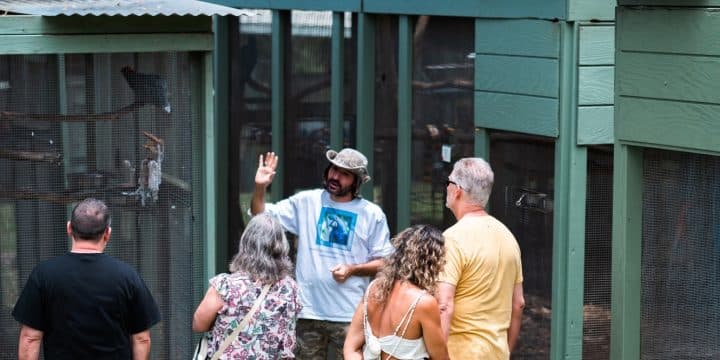
Casper is one of the many parrots that have been welcomed to Parrots in Paradise with bottomless patience, a healthy dose of caution, and a belief that even the most contentious parrots deserve love and the opportunity to be safe, be seen ... and be heard! On the lush grounds of this parrot rescue, rehabilitation, education, and adoption center in Kealakekua, displaced parrots — each with their own unique voice and distinctive plumage — find solace and care while living in open-air aviaries. Unlike traditional indoor cages, these large, secure enclosures enablethe parrots to enjoy fresh air, sunlight, and space to spread their wings and even fly.“ But during the last big storm, we had to bring many of them inside in the middle of the night,” says Dorothy, recalling the onslaught of damaging wind and rain from a kona low — a winter storm that sweeps in from the south. For over two decades, the sanctuary has provided safe shelter for the parrots, and in these extreme situations, the safest place is in the Walshes’ own home.
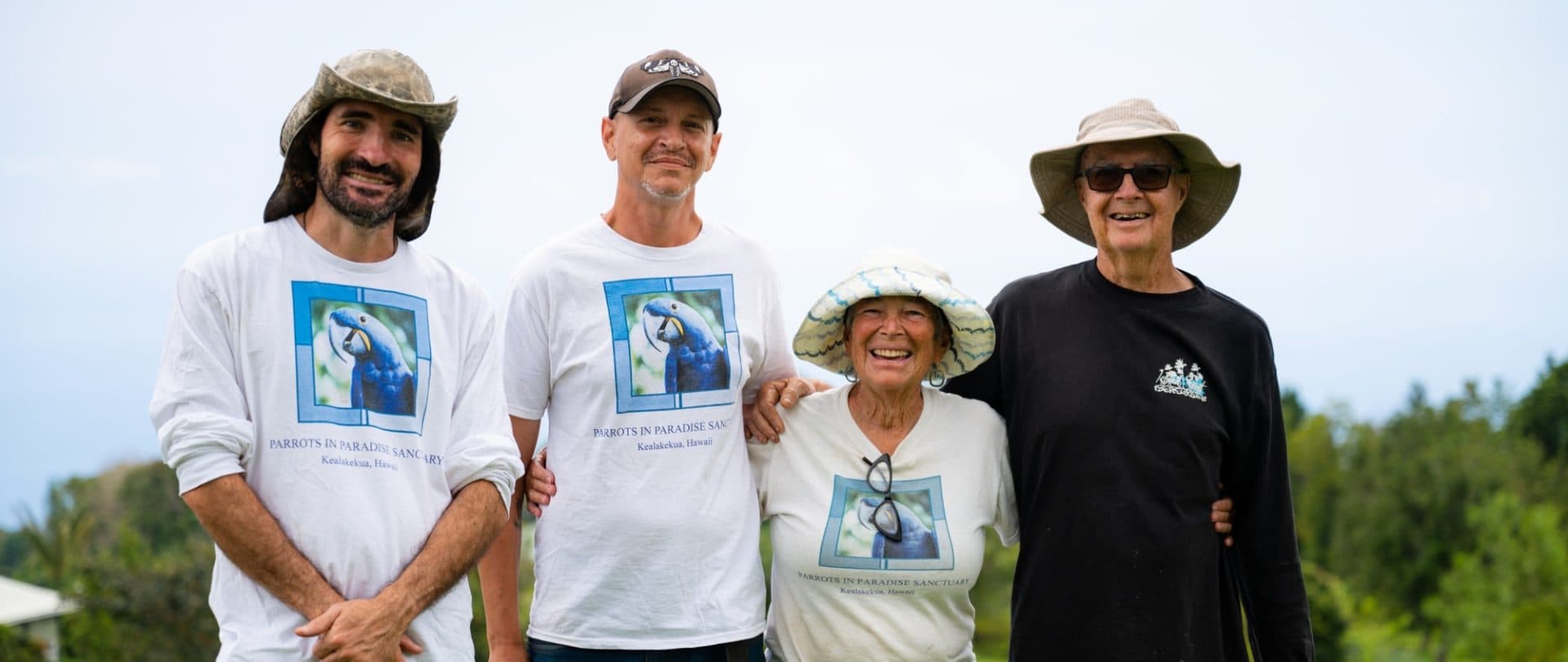
“Jerry and I didn’t always call Hawai‘i home. We both grew up in Southern California. As a kid, I never even had a pet, and I was actually allergic to birds. " I guess I outgrew that!” says Dorothy. “If someone had told me that I’d be living in Hawai‘i doing this after retiring as a nurse practitioner, I would have been shocked. But about 30 years ago, our daughter Erinnsaid something that changed the course of our lives.” At the time, Jerry had a garden center in Kainaliu, Hawai‘i. Nine-year-old Erinn noticed that people were surrendering their parrots to the center for an array of reasons, prompting her to declare that a sanctuary was needed. I didn’t want to tell her it was a ridiculous idea. And we did have a few parrots, mostly lovebirds, brought to us by people who couldn’t care for them. So, we put a little ad in the paper saying, ‘If you need help with your parrots, call us,’” Dorothy says. “That’s when people started calling, saying things like, ‘My dad has parrots. He’s got cancer, and he’s on his deathbed. I can’t take them. Can you help?’ We started getting so many calls that we had to form a nonprofit.”
Today, there are around 125 exotic parrots — from petite parakeets to majestic macaws — who now live happy, healthy lives at the sanctuary, surrounded by other animals that the Walshes have also rescued. At last count, there were peacocks, chickens, 21 goats, 15 sheep, four horses, two tortoises, five indoor cats, and Max the dog,” Jerry shares. Most are well adjusted to sanctuary life, despite the difficulties they’ve endured. Casper, however, is still a “handle with care” bird.
“But recently, something extraordinary happened ... Casper reached out to hold my hand. And once he grabbed on, he didn’t want to let go,” Dorothy shares. It’s these little moments of trust and healing that motivate the Walshes to continue protecting the parrots, even in the midst of life’s storms.“ When gusts of up to 75 miles per hour from thekona low tore through the sanctuary, aviary roofs lifted and disappeared into the darkness,” says Dorothy. The smaller birds were safe riding out the storm in place. Others sheltered under the garage eaves. But for the bigger birds, the conditions were far too dangerous. One by one, Jerry, Dorothy, and their son Jerry placed parrots into carriers and rushed them inside, where they set up heaters to keep them calm and dry.
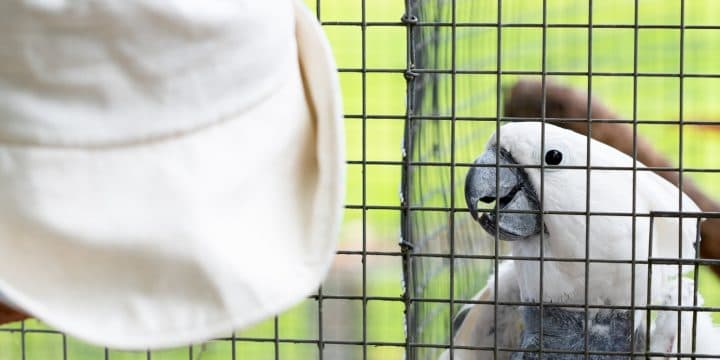
Soon, the house was full of 30 feathered rescues, including Kissie, the sanctuary’s mascot. A greater sulfur-crested cockatoo, Kissie was captured in Australia during a time when parrots were often brutally snatched from the wild for the pet trade. Kissie’s wings were clipped, so she couldn’t fly away. She never got her balance back, so she has to use her beak to stabilize herself,” Dorothy says. Kissie had different homes, eventually landing on O'ahu, where she lived with a loving, older caretaker for many years. When the caretaker passed away, his daughter traveled from Missouri to handle his affairs and personally flew Kissie to the sanctuary, so she could truly thrive.
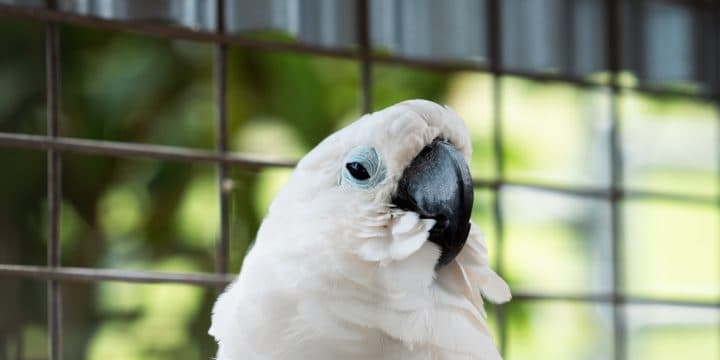
From the day she arrived, the cockatoo with a mohawk-like tuft was eager to perch on someone’s arm. “There’s not a person in the world that Kissie doesn’t love, so naturally, she became the sanctuary’s mascot,” Dorothy says as the aptly named Kissie gives her a parrot smooch. “I could have adopted her out 2,000 times already, but she is not up for adoption. She is exactly where she belongs.”
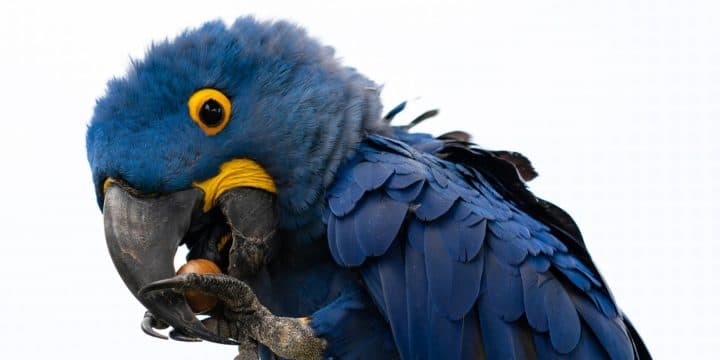
The same can be said for Huli, another O'ahu transplant. The hyacinth macaw once lived in a 300-square-foot apartment in Waikīkī with his sweet owner. “She’s 82 now. She wanted to make arrangements for Huli before something happened,” says Dorothy. Huli now dazzles visitors to the sanctuary with his periwinkle-blue feathers, accented by strokes of gold and crimson, and a wingspan of nearly four feet. And Dorothy calls his owner on O‘ahu nearly every week to give her updates. “This is so much bigger than being a refuge for parrots. Their companion-people also need to be shown compassion as they make heartbreaking decisions about their parrots. Most of them are well-intentioned individuals who really love their birds but just can’t care for them any longer due to health or financial changes.”
“C’mere!” Huli calls, beckoning all to admire him, along with the other hyacinth macaws he shares an aviary with. Macaws remember faces and speak in ways that convey a range of emotions, from curiosity and joy to mischief and even sadness. They should never have been in captivity. But now we can’t let them back out,” Dorothy says as Jerry feeds Huli a macadamia nut.
“This is Boaz. I found him as an egg when his parents abandoned it,” Dorothy says, offering a blue-and-gold macaw a mac nut of his own. “I raised Boaz from a chick, syringe feeding him for four months. ”The Walshes point out that all of this is possible because of donors, as well as volunteers who help pick mac nuts, rake leaves, and tidy aviary areas, such as the one Sky calls home. A Goffin’s cockatoo, Sky, came to the sanctuary from a home filled with constant arguing and verbal abuse. If he made so much as a peep, his cage was hit to silence him. Over time, the stress was too much, and Sky began plucking his feathers to cope — a habit that he just might overcome now that the intelligent bird is surrounded by gentle hands and kind voices at the sanctuary.
Through Parrots in Paradise, many of the most vulnerable birds who have been rescued and rehabilitated spend the day cruising around their aviaries, safe and loved, and watch the sun set into the ocean every night. They have a future ahead of them that’s as vibrant and bright as they are.
Learn more at parrotsinparadise.org.