


©2023 Savvy360, LLC. All Rights Reserved
PLAN A TRIP IN OUR APP


Guiding Light
In the mountains above Hanalei, painter Max Lemaire found his subject — and never stopped looking
BY Mary Troy Johnston
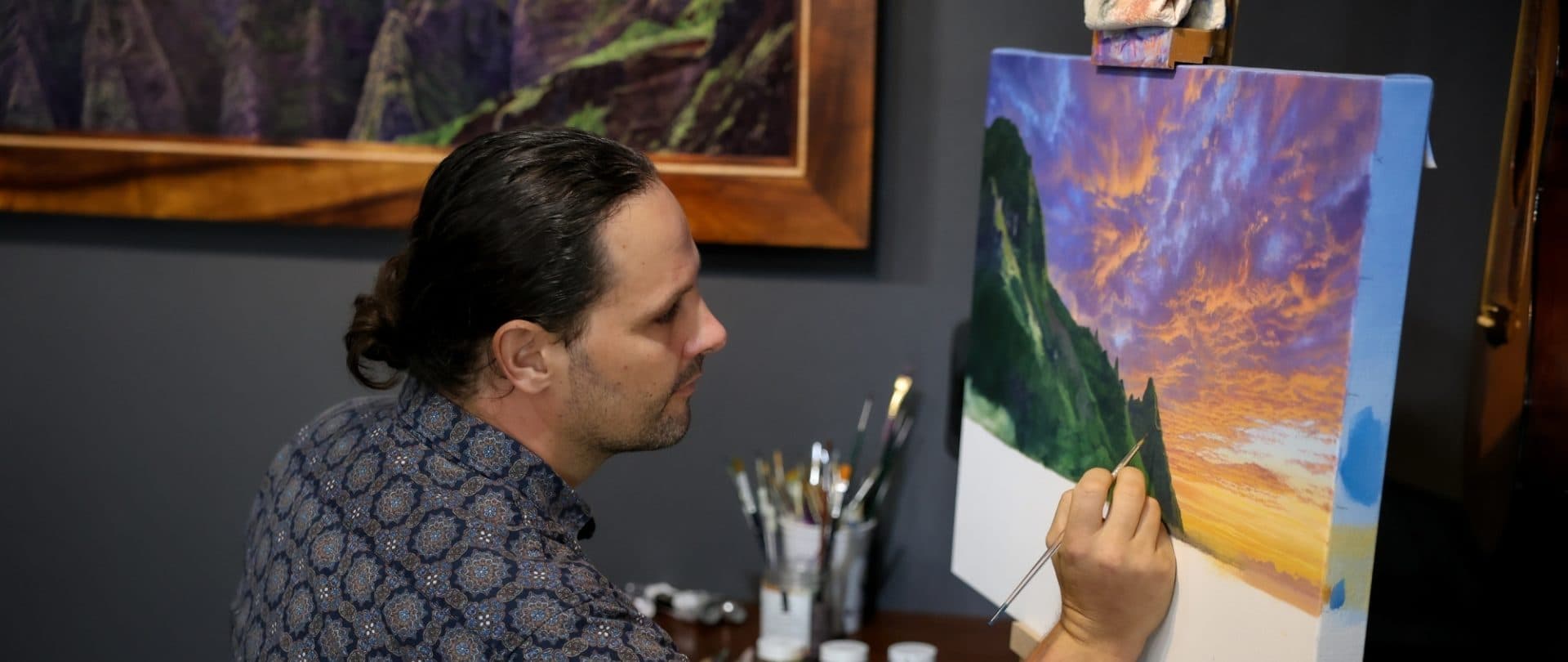
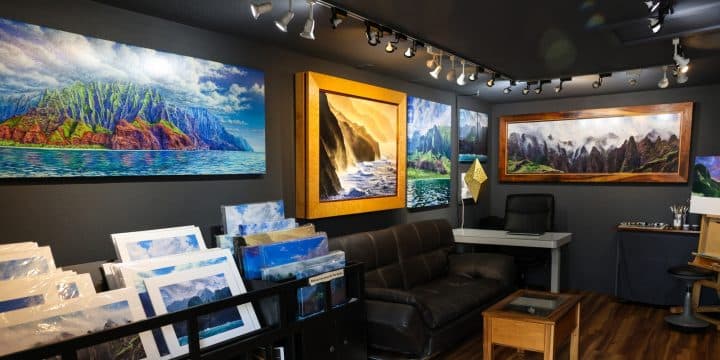
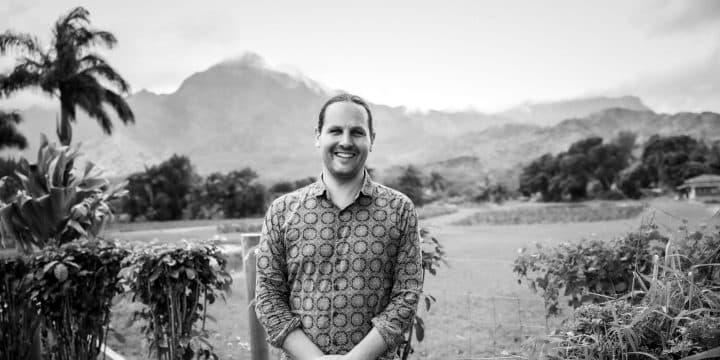
From his gallery in Hanalei, Max Lemaire has spent a decade with one of Kauaʻi's most dramatic views directly in front of him — the towering mountain ridge that rises behind the town, its upper reaches shifting between clarity and mist depending on the hour. It is the kind of landscape that rewards close looking. For Lemaire, it has become a sustained study in the behavior of light.
His body of work draws from sources as varied as the watershed feeding those mountains. Of Giovanni Battista Piranesi, who influenced him, Max says, "I loved the intricacy, and that he made these amazing experimental spaces with so much detail all from his imagination." Of Maxfield Parrish, after having seen his originals, Max says, "It changed something for me. His thing was transparency, letting the light move through the paint by laying down many thin glazes so the light bounces through the layers of paint, not off them." So many were the streams of influences and idiosyncratic personal experiences that have culminated in his original style.
In 2015, Max became a gallery owner, and its location in Hanalei gave him constant viewing privileges of the towering mountain ridge forming a dramatic and often misty backdrop. This period also coincides with the artist's deepening practice of developing his own techniques to emit and capture light. A decade ago, he says, he would not have been able to achieve the painterly effects he has since acquired through much experimentation. Max talks about "being able to be comfortable in the weeds" of creating a painting. According to the painter, "The moments of each smaller area in the painting are individually abstract but together make the illusion of reality." This gradual process can mean that the objects of his creation may not reveal themselves during the early stages, requiring the artist to have faith that "the weeds" will eventually mature as a complete work.
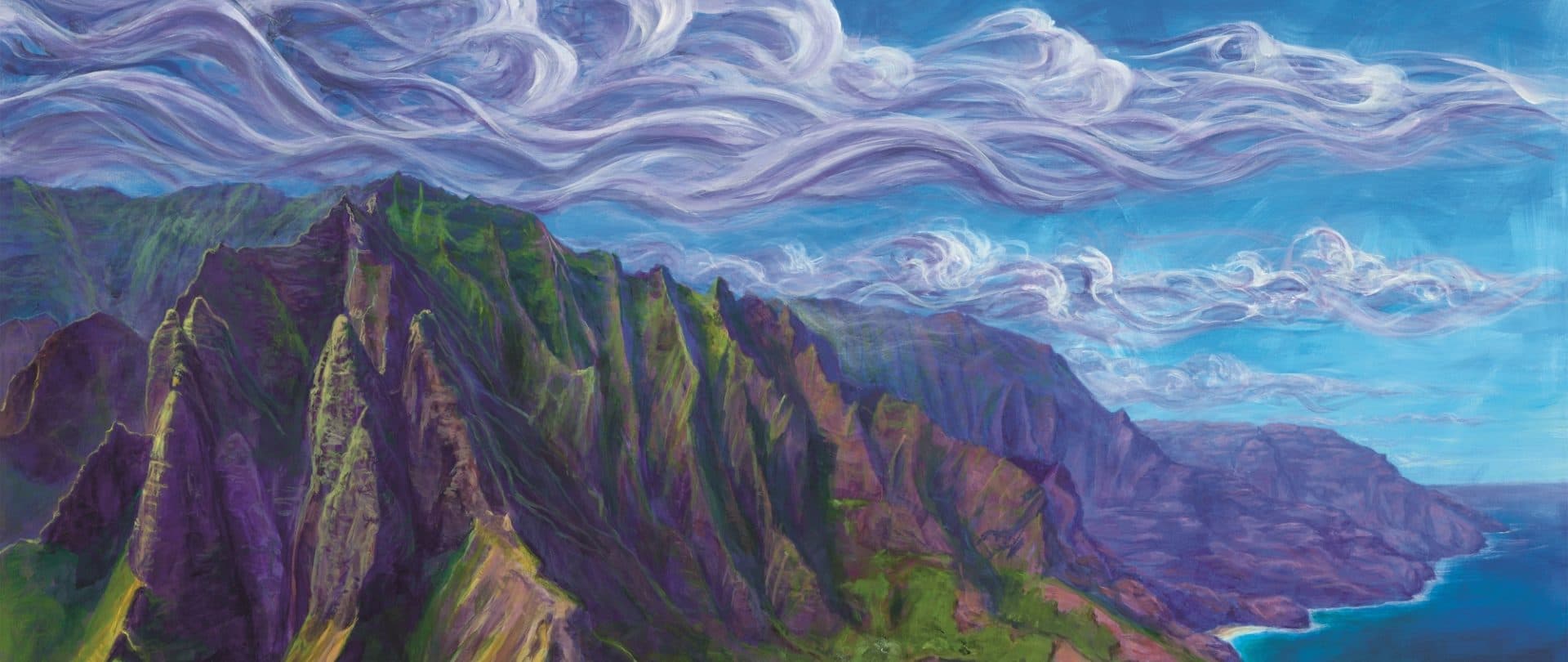
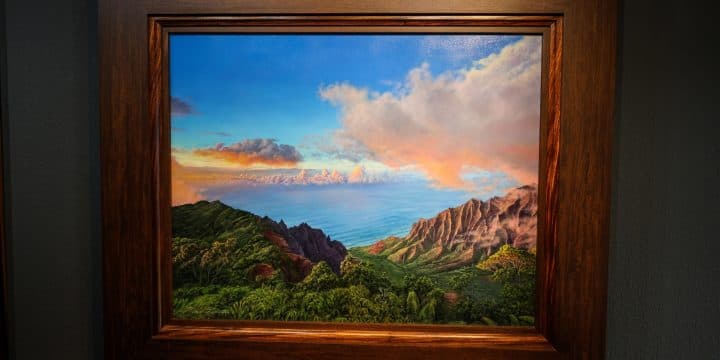
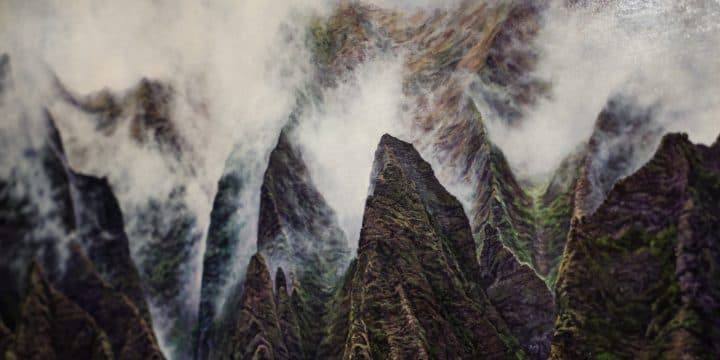
Max underwent an important transition in his art from being a visionary artist to becoming a landscape painter. A painting he did in 2016 called Spirits of Kauaʻi speaks to the crossover. Swirly, breathy clouds hover over the sculpted mountains above Kalalau Beach, whimsy meeting realism, magic infusing the material world — a painting that is equally floaty and grounded. This painting demonstrates the scope of imagination combined with intimate knowledge of the landscape.
Max learned early on to listen to light. When he was younger and working in New Zealand carving wood to make furniture in his shop, he noticed a bright blue light flash that he describes as "pinhole size." When he made the cut in the wood, he noticed it again. He measured the board and realized it was too wide. From then on, he decided to pay attention to the mysterious appearances of light and, in his words, became determined "to listen."
Listen he did — through the years, to the point of being able to paint light. His understanding of light "as part of higher-plane guidance and intuition" led to his conscious study of how to affect and utilize light in his paintings. He speaks of a low cloud illuminating the top of the mountain, much like the light of a chandelier transforms a room. "I feel it," Max says. "I try to use light to make people feel what I am feeling." According to Max, he is attracted to "the hallelujah moment" — when, for instance, "the sun probes through, and the sky lights up. For this brief window, the light is revealing something. It is a matter of seeing it." Max elaborates: "Seeing it is about switching from contextual reality to seeing the elements as color, shapes, and layers so I can translate the experience. We go from forgetting the meaning of what we are seeing to describing the shape and color of it, so ultimately we can get back to the feeling and the meaning. It comes full circle."
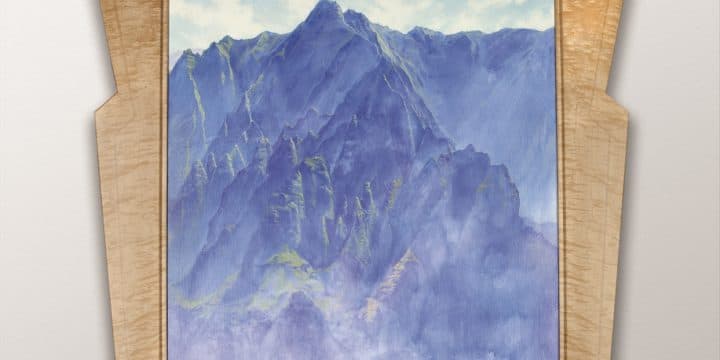
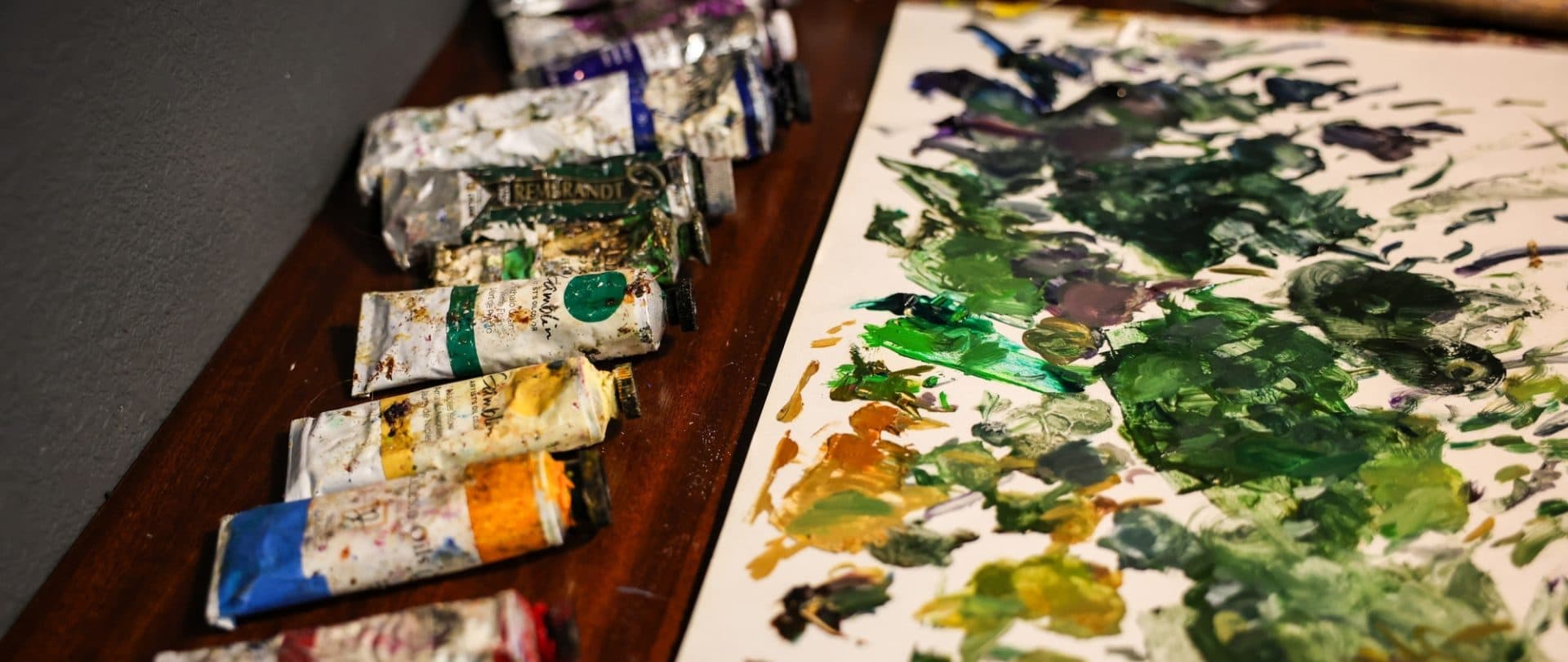
Thus, painting becomes a personal journey. For Max, it is a journey of thousands of brushstrokes. As a solo painter in a remote location, he describes having to figure out on his own the techniques needed to portray light accurately. He observes, "When you look at something in the distance, it fades off because of atmospheric effects." Max began to work with glazing to provide similar effects — finding, for example, that a glaze shifted toward purple and gray could alter saturation and contrast. It is one of the many ways in which the artist recasts atmospheric effects in paint.
The discoveries along the way derive mostly from trial and error over many years, but they are also deeply intuitive. He credits his practice of reiki with becoming "more intuitive and guided." Max recounts learning how to surrender "over into inner guidance," letting "an invisible hand guide his hand" as he became the conduit for healing energy.
A favorite painting, Timeless Light, attests to his skill in conveying soft and diffuse light. "The mountains in the painting were painted with more detail and then glazed back to give depth," Max explains. That same depth achieved a softening of light — a real atmospheric effect on Kauaʻi that occurs when the mountains are shrouded in mist. Timelessness has increasingly become a theme in his work. He is prone to remove the human element from the composition so that the landscape might appear as it did in ancient times.
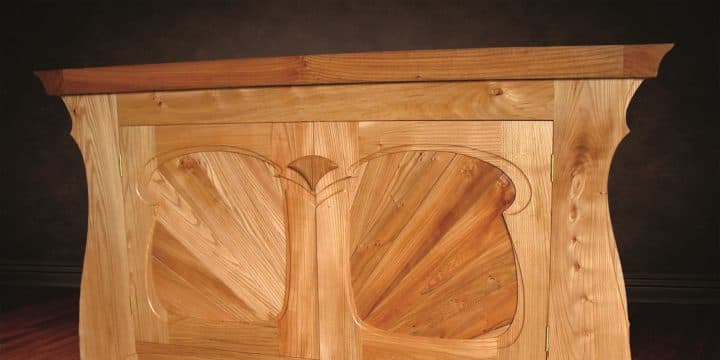
Many of Max's earlier interests are resurfacing in his art. This is especially true of his fascination with woodworking, instilled in youth by his father, who shared carpentry skills with him — making woodworking jigs among them. While in art school, Max took courses from a master luthier who did restoration work with stringed instruments and built exquisite classical guitars. Max further refined his craft. In New Zealand, he began making furniture and remembers having "the opportunity to try some very technical joinery and creative projects."
Returning to Kauaʻi in 2010, both art forms — painting and woodworking — rose to new heights and became all of a piece, completing the presentation. He built unique frames for his paintings, which were becoming more and more individualized as a result of his pioneering painting technique. Where a frame might otherwise create a boundary, the union of painting and frame by Max creates a sense of harmony and amplification — two bold artistic forms combining to compose greater artistry. His process with framing is equally intuitive: a finished painting at last finds its mate in the koa boards waiting patiently in the shop; ultimately, the mountain ridges join with the ridged grain of the wood frame.
Max feels his spiritual seeking dates back to his youth. He remembers enjoying art in high school created by "free association," in which the artist focuses freely on what comes to mind. He enjoyed spontaneous drawings and mark techniques and what he describes as "elemental things like building textures." During this period, he believes he was "subconsciously seeking sacred geometry." Chance would have it that he began to find books on the subject. It became apparent to him that the principle informed everything — that "lattices of atoms occur at specific angles." He began to incorporate sacred forms into his art and woodworking. For him, "reality is elegance and beautiful geometry."
That prior experience may have helped him recognize the sacred on Kauaʻi. Nowhere is this reverence seen better than in his painting The Guardians. The location is Kalalau Beach, where from shore one looks up to the Kalalau Cathedrals — majestic, towering, spired mountains that evoke what Hawaiians call mana (life force). Mana is believed to be present in nature and connects individuals with ancestors who may provide protection and guidance. The way the clouds are intertwined with the mountains symbolizes that the Guardians, too, have their place in the heavens. Max describes the circumstances of the experience: "The inspiration for The Guardians came during a trip to Kalalau during COVID. The Department of Land and Natural Resources and locals had cleared out all the campers and refuse in the valley. It was empty for months, pristine, not even footprints on the sand. We boated in and arrived with this magnificent cathedral valley to ourselves."
The journey of thousands of brushstrokes is also an interior journey — of light, listening, intuition, refinement, imagination, and transcendence. For the artist who states, "I love worlds that only exist in paint," Max Lemaire is meaningfully suspended among many different worlds: some of them real, some of them less so, and some of them accessible only to his spirit. Of his work, he concludes: "I work on decoding the world into color and pattern and then remaking it my own way. That's pretty cosmic and meta." One only has to behold his work to understand.
Max Lemaire’s studio, Infinite Arts, is located in Ching Young Village Shopping Center, 5-5190 Kuhio Hwy, Hanalei; (808) 755-5605; infinitearts.com