


©2023 Savvy360, LLC. All Rights Reserved
PLAN A TRIP IN OUR APP


Forest in Flux
The Kahakapao Loop Trail offers a surprising escape into a forest shaped by more than a century of human influence.
BY Serene Gunnison
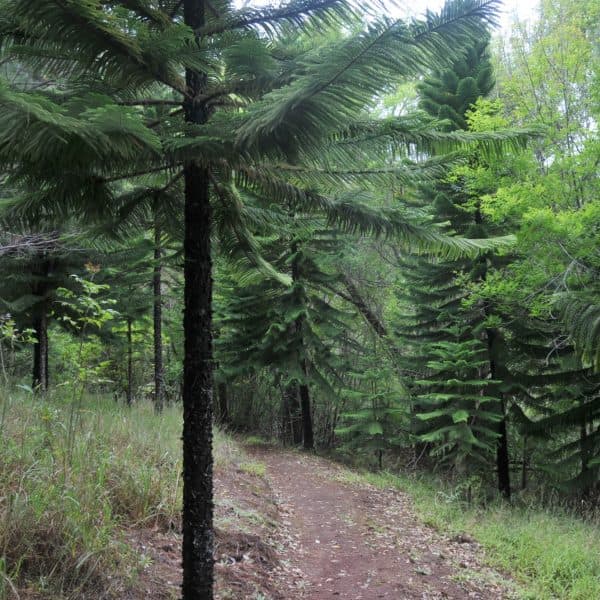
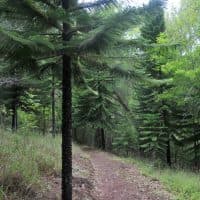
On the cool, northern slopes of Haleakalā, the six-mile Kahakapao Loop Trail winds through a lush, misty forest that feels strikingly out of place on Maui. One of several trails in the 2,093-acre Makawao Forest Reserve, Kahakapao Loop is dominated by thick stands of non-native trees. At 3,000 feet, temperatures are cool. Fog often hangs in the canopy, while moss and ferns bathe the forest in green. It’s a version of the tropics few visitors expect. Yet, Kahakapao Loop Trail is more than just a unique escape. The trail is a living piece of Upcountry history and offers a glimpse of the area’s changing landscape.
The Kahakapao Loop Trailhead is a short drive mauka (uphill) of Makawao—a historic ranching town that’s now a popular destination for dining and shopping. Makawao was once the hub of Upcountry Maui, supporting a thriving community centered on cattle ranching and sugar plantations. To reach the trail, head up Kahakapao Road via Pi‘iholo Road, where acres of pastureland hint at Makawao’s paniolo (cowboy) heritage.
From the trailhead, Kahakapao Loop climbs through a dense forest of eucalyptus, tropical ash, pine, and other non-native species. The path threads through gulches and across ridgelines, gradually gaining 1,200 feet of elevation. Cool temperatures, iron-rich red soil, and the scent of fragrant conifers and hardwoods offer an unexpected contrast to Maui’s sunny coastlines. But the forest didn’t always look this way. Two hundred years ago, this area was home to native trees like ‘ōhi‘a, koa, and ‘iliahi (sandalwood). By the late 1800s, ranching and logging had decimated forests throughout Maui’s uplands. The loss of native canopy caused severe erosion and disrupted natural water cycles. In Hawai‘i, healthy upland forests act like sponges—capturing rainfall and recharging groundwater.
To counter the damage, Hawai‘i’s first territorial forester, Ralph Hosmer, established a system of forest reserves to protect these critical watersheds. Hosmer officially dedicated the Makawao Forest Reserve for conservation in 1908. However, instead of restoring native species, Hosmer prioritized fast-growing, non-native trees that could stabilize the watershed quickly. Decades later, in the 1960s, the State Division of Forestry launched a massive reforestation campaign at Makawao Forest Reserve. With help from inmates at the now-shuttered Olinda Correctional Facility, crews planted thousands of trees. The result is a towering, mixed forest that feels more like the Pacific Northwest than a Pacific island. Today, when you walk the Kahakapao Loop, you’re walking a piece of Upcountry’s history.
Despite the dominance of introduced trees, native species persist in the forest. Lucky hikers might see or hear native forest birds like ‘apapane and ‘amakihi flitting overhead. Endemic plants like māmaki, maile, and ‘ie‘ie grow in patches along the trail’s edge. Giant hāpu‘u ʻiʻi (Hawaiian tree ferns) unfurl in the gulches while endangered hala pepe trees cling to cliffsides. Tiny native snails and happy-face spiders hide in the undergrowth. Even some koa and ‘ōhi‘a trees remain, reminders of the forest’s original makeup. Although the reserve dates back over a century, the Kahakapao Loop Trail is a relatively new addition. Makawao Forest Reserve opened for public access in 1997, but it wasn’t until 2003 that volunteers—working alongside the state’s Nā Ala Hele Trails and Access Program—began carving out a trail system designed for hikers, mountain bikers, and equestrians. Their flagship creation was Kahakapao Loop, followed by a series of bike-only tracks that now crisscross the forest.
Today, Kahakapao Loop is one of Maui’s most popular mixed-use trails—and it still relies on kokua (help) from volunteers. Local organizations, such as the Sierra Club Maui Chapter, host regular volunteer workdays. These hands-on events focus on trail upkeep and invasive species removal, offering visitors a chance to give back while forging a deeper connection to the forest. However, that connection can come in many forms. While hiking draws most visitors, those seeking a faster-paced adventure might opt to mountain bike. Rather than lug a bike across the Pacific, riders can rent gear at Krank Cycles, just down the street on Makawao Avenue. Kahakapao Loop Trail is just one of many mountain biking trails within the Makawao Forest Reserve, with routes that cater to all ability levels—from toddlers on pushbikes to seasoned pros.
Regardless of whether you’re on two wheels or two legs, the Kahakapao Loop Trail is a tour through changing environments. You’ll move through groves of fragrant pines, corridors of beautiful-but-invasive Himalayan ginger, and past quiet picnic spots beneath endemic hala pepe trees. However, the most striking section of the forest cuts through a sea of native kupukupu ferns, their serrated edges pointing skyward beneath a canopy of tropical ash trees. Like many of Maui’s forest reserves, Makawao Forest is a landscape in flux. While past restoration efforts helped protect the island’s watersheds, they also created monocultures of non-native trees and invasive species that continue to outcompete native plants. In many ways, hiking this forest is like walking through a timeline of human influence.
Before hitting the trail, come prepared. There’s a small parking area at the trailhead with informational signage, but no restrooms or trash cans. The loop is well-marked and easy to follow in either direction. Be ready for changing weather—fog and light rain are common, and conditions can be muddy after a storm. Closed-toe shoes and plenty of water are musts. You can also help ensure the health of the forest and native species within by using the provided boot brush stations to avoid tracking in invasive seeds or pests. Kahakapao Loop may not offer dramatic coastal views or waterfalls, but what it delivers is just as valuable: a surprising mix of native and non-native life, and a deeper understanding of how people continue to shape—and restore—Hawai‘i’s forests.
Makawao Forest Reserve | Kahakapao Loop Trail | Mountain Biking Trails; From Makawao Town proper at the intersection of Baldwin Ave. and Makawao Ave. (Highway 365), drive northeast (left on Baldwin) and turn right onto Pi‘iholo Rd., left onto Waiohiwi Rd., and right onto Kahakapao Rd. The trailhead is at the end of Kahakapao Rd. Gates are open from 7 a.m. to 7 p.m.
Krank Cycles (bike rentals); 1127 Makawao Ave., Makawao; (808) 572-2299; krankmaui.com; Open daily, 10 a.m. to 5 p.m.
Sierra Club Maui (volunteer opportunities); (808) 867-6001; mauisierraclub.org/volunteer.

See + Do
See + Do
See + Do
See + Do
See + Do
Eat + Drink

See + Do
See + Do
See + Do
See + Do
See + Do

Eat + Drink