


©2023 Savvy360, LLC. All Rights Reserved
PLAN A TRIP IN OUR APP


At Home in the Hive
Natalie Schack
BY Purpose, community and the pursuit of bees at Beelieve Hawai‘i
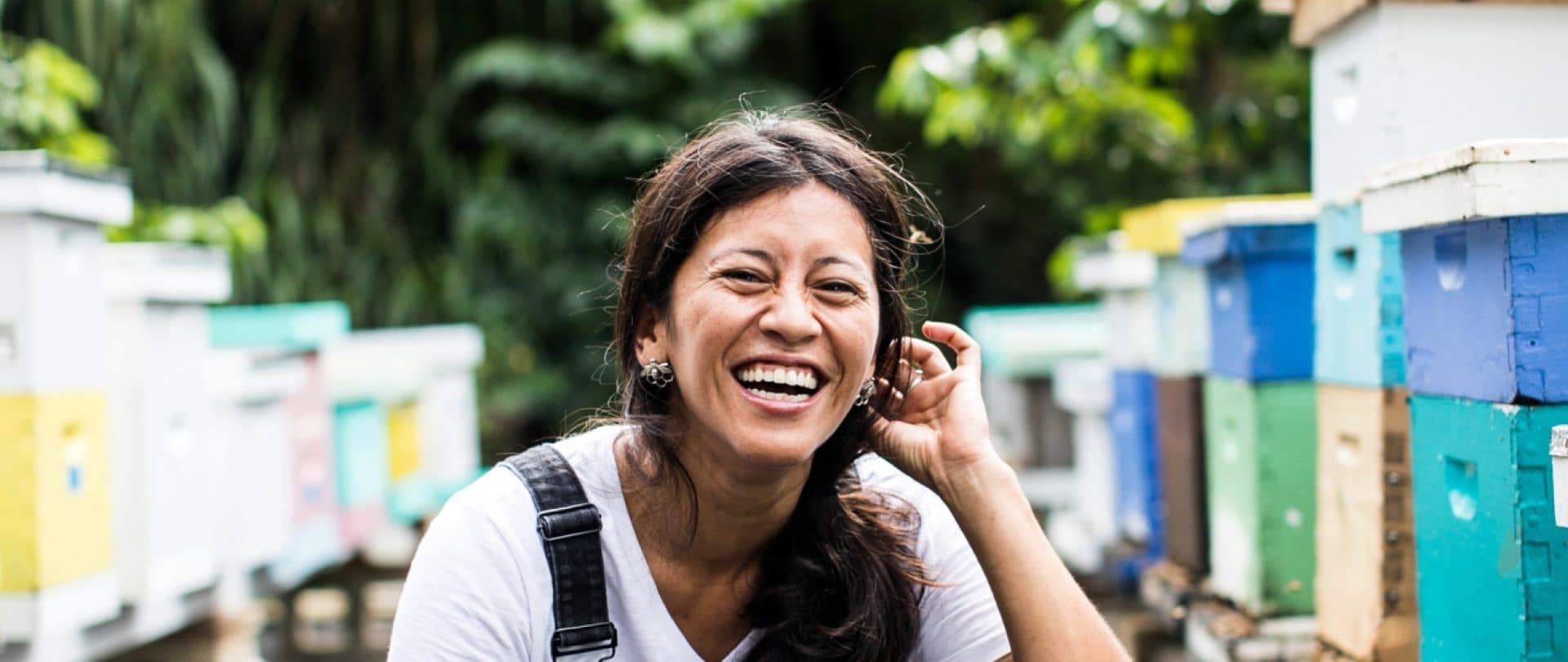
Listen to Jasmine Joy, founder of Beelieve Hawai‘i, wax poetically about her beehive removal services, her beekeeper courses, her strong connection with these insects or how bees are part of myth and spirituality, and you’ll immediately understand: for her, bees go deep. And yet, the first lesson Joy remembers about beekeeping is not about bees at all, but about fear.
She is four or five years old, standing at the bottom of a grassy hill, her small body anchored in place by a voice she trusts. Her abuelito (grandfather) wears a white suit that makes him look, to her, like an astronaut preparing for liftoff. Before he walks away and crests the hill toward the stacked white boxes waiting in the sun, he turns back and says one thing to her.
“I don’t even remember bees, really,” remarks Joy. “I just remember him telling me: Don’t be afraid.” The details are muddled, but what lingers is the instruction, the calm certainty of it: “Don’t be afraid.” Years later, that sentence will reveal itself as a kind of compass — one that, like the sun for a honeybee, quietly orients her through seasons of loss, searching and returning. For a long time, Joy didn’t know she was looking for bees. She only knew she was looking for purpose. In the end, they were one and the same.
Born in Los Angeles to a Filipino mother and a Nicaraguan father, Joy grew up feeling the weight of fracture early. Her paternal lineage carried beauty and brutality side by side; her grandfather kept bees but abuse also threaded through that family line. By the time she was eight, Joy had walked out of her father’s life entirely. Survival demanded self-reliance. Healing demanded something harder: connection.
She gravitated toward living things … bugs, gardens, animals. As a child, she collected insects without fear, cupping them gently in her hands. She imagined futures that revolved around care, like working with children or protecting animals, something that would make the world a better place, whether broadly or intimately. Jane Goodall became a north star. Some people dream of stardom, but Joy dreamed of service.
In her twenties, her restlessness found expression in movement and the ocean. She moved to Hawai‘i in 2006, ostensibly for school, but really for the water. She became a professional skimboarder, then a sponsored athlete, riding the thin, volatile edge where ocean meets land. Skimboarding suited her: a young sport, overlooked, underestimated, the perfect frontier for a trailblazer who wasn’t afraid to forge her own line. But even as she ran a skimboarding company, organized beach cleanups, and mentored young riders, something felt unfinished. The work was good, but it wasn’t … whole.
The pivot arrived quietly, the way many callings do. In 2011, Joy was living on O‘ahu’s North Shore, newly relocated from town. A friend came home one day with skincare samples from Honey Girl Organics, a company in Pūpūkea that made products from beeswax and honey. They were hiring, and Joy needed work. She took the job and unknowingly stepped into a lineage.
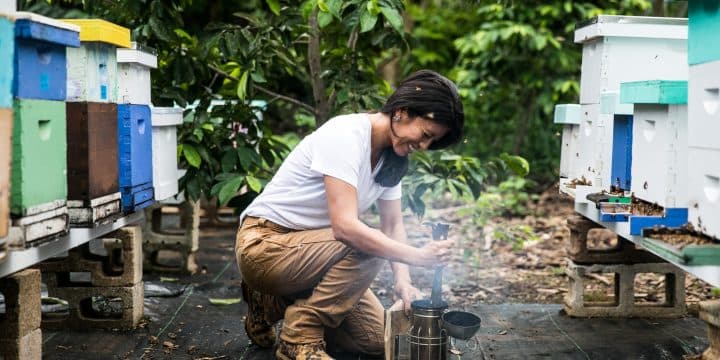
Honey Girl Organics kept hives on site. Beeswax and honey weren’t abstractions; they were these humming, swarming, very much alive things. Co-founder Anthony Maxfield became her first mentor in apiculture, or beekeeping. She learned the science and the patience, the physicality and the reverence. “There were hives on the site, and they would swarm occasionally. That’s how I learned how to catch my first swarms, just there on site.”
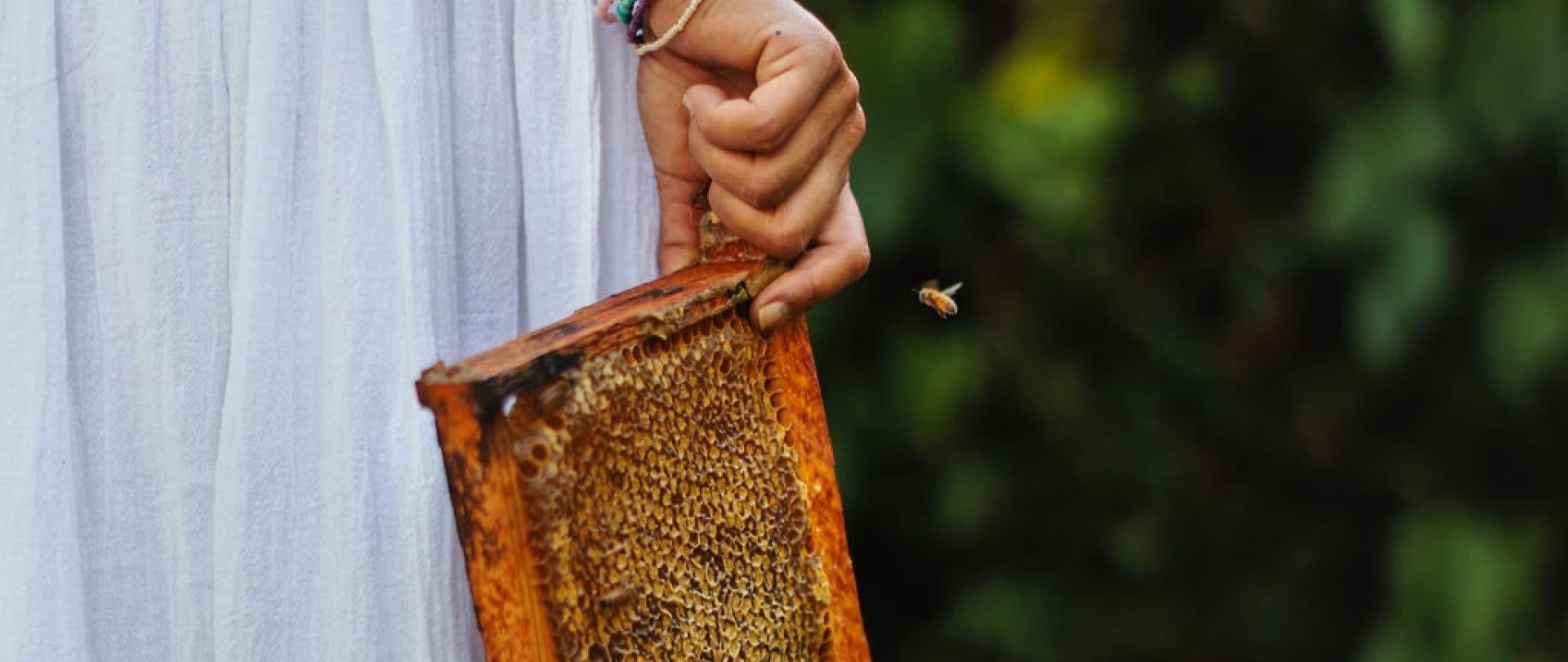
Then came her first rescue. A friend at Waimea Valley had an established hive living inside a house wall, a situation most exterminators at the time still solved by killing bees outright. Joy asked Anthony to help her remove it properly, cutting into the structure to save the queen, keeping the workers and the whole living system intact. This kind of work is called a cutout, and it is neither fast nor easy. It is, however, humane, characterized by a deep sense of respect for and commitment to these magnificent, unique creatures.
Around that same time, Colony Collapse Disorder was entering the public consciousness. Honeybees were dying in alarming numbers. And yet, in Hawai‘i, exterminators were still legally poisoning them. Joy couldn’t reconcile that. In May 2012, she founded Beelieve Hawai‘i.
It began as a response to the lack of humane bee removal on O‘ahu and to the normalization of shortcuts that treated living superorganisms as disposable. Even the official channels troubled her. The Hawai‘i Beekeepers Association maintained an approved list of rescuers — some of whom, under the justification of controlling the spread of harmful mites, practiced lethal “drill-and-kill” methods instead of true removals. Joy knew there were other ways, and she was determined to save as many hives as she could using them.
Beelieve Hawai‘i grew into a reputation and then into a calling. Joy became one of the state’s leading bee removal specialists, known for bee rescues others wouldn’t attempt. In August 2020, at the height of the pandemic, she and her team were entrusted with an extraordinary task: removing four aggressive, established hives from the towers of ‘Iolani Palace. The job was an intense one, requiring Joy to work in a lift fifty feet in the air for a week, which was so precarious that Joy prayed before each ascent. The bees at ‘Iolani Palace also carried dark German genetics, more defensive than their Italian counterparts, and their stings had already driven concern for staff and visitors. For Joy, though, the work was not just technical. ‘Iolani Palace is the only royal palace in the United States, a site heavy with history and grief. Caring for life there and removing it without destroying it felt like alignment. Alignment, incidentally, is a concept that comes up often when Joy speaks about bees, which work by light, rhythm, and relationship.
Honeybees are not native to Hawai‘i. They arrived in 1857, transported by ship from California, and quickly flourished in the islands’ forgiving climate. “Most people don’t realize that honeybees are true solar animals,” she explains. “We would need to put them under a microscope to see their three simple eyes in between their antennae called ocelli, which see ultraviolet. So, from the moment the sun rises till it sets, the sun is their compass, and that’s how they’re able to fly and orchestrate and find their way around to all the flowers and all the botanicals in the ecosystem.”
Joy understands them as teachers. A hive is a matriarchy, a living superorganism. The queen lays up to 2,000 eggs a day and does nothing else; she is supported entirely by her daughters. Worker bees move through a lifetime of roles, from cleaner to nurse to builder to guard to forager, each transition seamless and unforced. When a bee stings to protect the hive, she dies. Protection is a sacrifice. Community is survival.
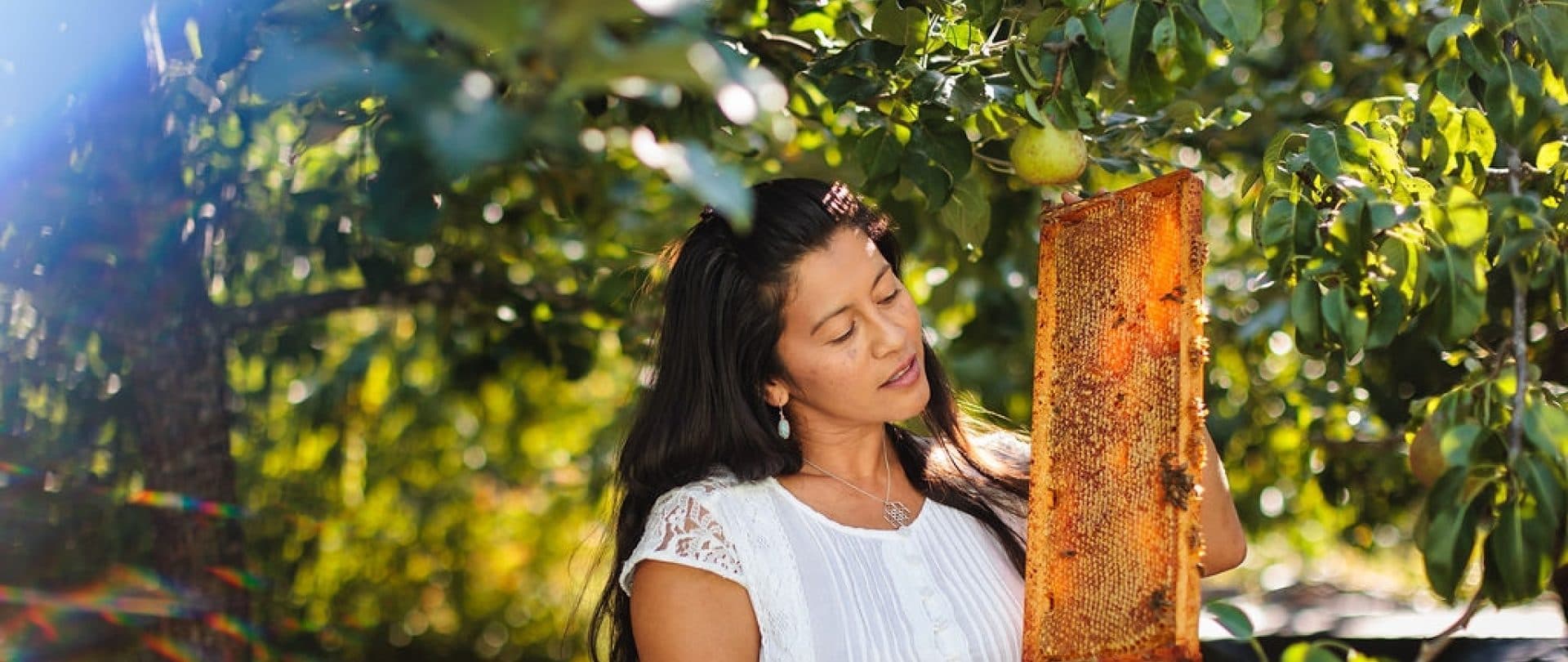
“Anytime I open a beehive,” Joy says, “I’m in a temple.” She asks permission before entering. She moves gently. She believes intention matters, and that bees feel it, register it, and respond.
For her, the intimacy is not metaphorical; it is lived. Joy came to bees during a breaking point. The relationship she was in on the North Shore was toxic, echoing earlier wounds. She was unraveling. The bees arrived not as a hobby but as a mirror. “They came to save me,” she says. “And now I protect them and save them. I don’t feel separate from them. I feel like I’m a bee. That’s how close I feel to them.”
What she found in the hive was what she had been searching for all along: community without hierarchy, power without domination, purpose without violence. The bees became kin in a way that her own kin could not. From that realization, when rescue was no longer enough, Beelieve Hawai‘i expanded into community building and education.
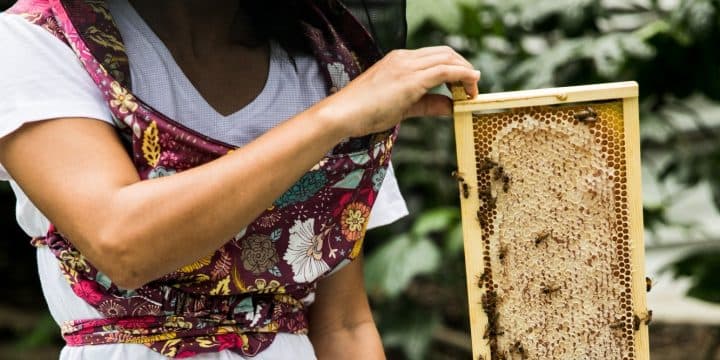
The shift began with Mākaha Elementary School. When they asked if Joy wanted to teach third graders about pollinators, she said yes without hesitation. She built a curriculum. Then another. Soon, her work had a new axis. “That’s how my full circle — my full hexagon — came to rescue, relocate, rehabilitate, and educate.”
From there, the learning and knowledge exchange opportunities bloomed. Joy’s Pollinator Outreach Program, POP Talks, formalized what had already become instinct. She brought observation hives (wooden suitcases with clear windows that revealed the intimate choreography of a living hive) into classrooms. Children watched the bees in action — vibrant, bustling, and intimately connected. She taught them that bees don’t want to sting. That a single act of defense costs a bee her life — for the sake of her hive. The lessons landed.
“I go, ‘Do you know how brave she must be to sting you? She did. You know what happens when she stings you? She sacrifices her life to protect her whole family.’ And the kids, they suddenly have this wonder when they hear the word brave, and then they’re like, ‘Wow. She is.’”
At Hanahau‘oli School near Mānoa, Jasmine became an after-school enrichment teacher, weaving pollinator education into gardening and ecological literacy. She earned certification as a school garden teacher, then reshaped that framework through a pollinator lens rooted in empathy, observation, and relationship. Currently, she’s the garden teacher at Earth School Hawai‘i in Hanalei on Kaua‘i. She dreams of helping to create a generation raised with reverence rather than domination — kids who would grow into gardeners, farmers, and protectors.
“I feel like, wow, if as I get older, there’s these kids that grow up into adults, and they’re like, ‘I remember Aunty Jasmine, she taught us about the bees,’ I feel like my mission is complete.”
It was during the pandemic that Joy noticed another shift. People weren’t calling for rescues; they were calling to buy bees. Backyard beekeeping surged as isolation sent people searching for connection, but Jasmine refused to sell bees into ignorance. Instead, she built Beelieve University.
The 16-week mentorship program began as a response to demand and evolved into one of her most ambitious offerings. Part education, part initiation, the program is structured around four quarters: the ancient lineage of beekeeping; hive mindfulness and collective intelligence; biology and behavior; and environmental integration.
Students don’t just learn how to keep bees. They study the spirit of the superorganism. They trace apiculture from antiquity to now. They learn how honey is made and design pollinator-friendly gardens as a final act of reciprocity.
Graduation comes with responsibility. Hawai‘i-based students receive a hive only after completing the course. Mainland students must source ethical, treatment-free bees locally, forging new relationships Joy helps vet and cultivate.
In this way, Beelieve University extends beyond Hawai‘i, stitching together a broader human network aligned with her values. Joy’s brand of education is not extraction but continuity.
In 2025, she began again, partnering with the Hyatt Regency Waikīkī to bring urban beehives and an accompanying immersive beekeeping experience to the beachfront resort, where guests and locals alike can learn the ways of “hive-mindfulness” and get up close and personal with Hawaiian honeybees. That continuity carried her to Kauaʻi. On the Garden Isle’s North Shore, teaching inter-island, expanding Beelieve University into hybrid cohorts, and stepping into that new role at Earth School in Hanalei, becoming the garden teacher as the school prepares to open its permanent campus.
The timing felt deliberate. Earth School had existed for eight years, rooted in community space, but now it’s growing structures, putting down deeper roots. Jasmine joined at the threshold. It is a familiar position for her. Thresholds are where she does her best work.
Today, Beelieve Hawai‘i is many things: a rescue service, an educational platform, a philosophy. It exists in hives and classrooms, in temples and gardens, and in the quiet trust between a woman and a swarm.
Jasmine still believes in not being afraid. She believes in matriarchies that operate through care, and work that heals and protects both the giver and the receiver. She believes in communities, both human and other-than-human, that thrive through balance.
When she opens a hive now, she sees herself reflected: a being shaped by purpose, sustained by others, essential because she participates. The search has come full circle.
In the hive, she found a home.