


©2023 Savvy360, LLC. All Rights Reserved
PLAN A TRIP IN OUR APP


Mural Mana
Kamea Hadar: leaving the world more beautiful
BY Natalie Schack
Most people encounter Kamea Hadar’s work in passing.
His murals are seen through windshields and bus windows, from sidewalks and crosswalks, folded into the daily visual traffic of Honolulu. They are passed and repassed, becoming part of the city’s backdrop rather than destinations in their own right. Between work and home, friends and family, his work is as omnipresent as the city itself, and as much a part of its happenings as the people within it. Hadar’s work is rarely experienced in stillness. It lives in motion.
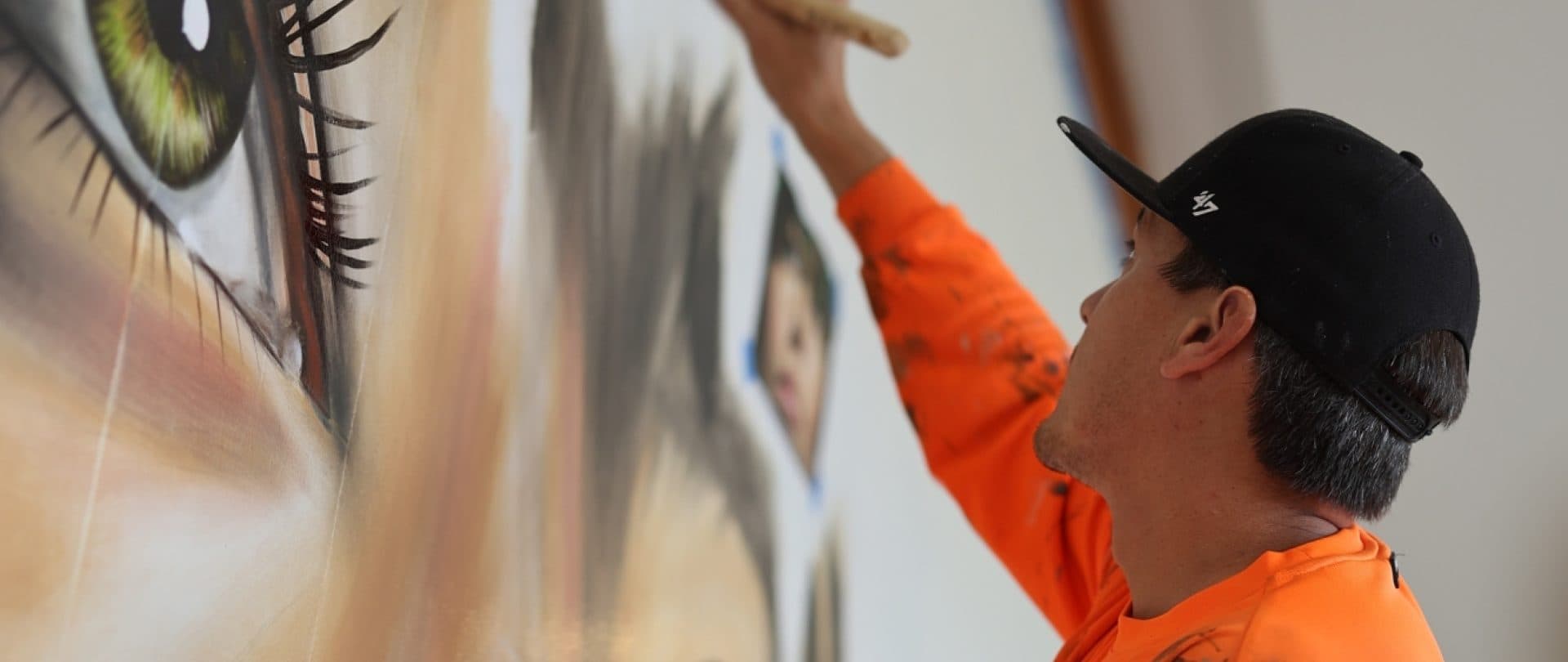
Hadar, a Honolulu-based artist whose murals now number over 50 in the past decade, has built a career painting at scale — sometimes monumental scale — across Hawai‘i and beyond. It’s a prolific time for him, whose work appears, it feels, everywhere: on freeway-facing walls, residential towers, storefront facades, and commercial buildings, often in places where art is not expected to linger but simply exists alongside daily life. “Nowadays it’s like, I’m always busy with something, and then when I’m not busy with work, I have my three kids,” he reflects. “But every artist dreams of being in demand and making a living and providing for their family through their art. I’m living every artist’s dream.”
Hadar’s significance in Honolulu is both tangible and invisible. You see it in the towers of color along the freeway, the massive murals that punctuate Kaka‘ako, and the careful curations of artists he champions. But it’s also in the smaller, quieter ways: helping emerging muralists navigate the ropes, partnering with local brands, connecting artists with work. He knows the streets, the stories, and the people — he knows that Duke Kahanamoku’s statue isn’t just a landmark, but a reminder of lineage, pride, and aloha, and that Carissa Moore riding a wave is more than a photo op; it’s history in motion. For Hadar, every wall, every façade, every store is an opportunity to embed the story of Hawai‘i in plain sight.
“I’m biased, and I obviously think that the more art in the world, the better. That’s kind of my life goal: just to leave the world a more beautiful place than I found it. And the way that I personally do it is by painting, and then also through my children. So, if I can paint as much as possible, spread art as much as possible, then that’s how I can beautify the world.”
Hadar’s roots in art trace back to his youth. His background is a very formal fine arts one, studying figure drawing in oil on canvas and even spending some time in Paris for his education, absorbing techniques while remaining deeply tied to his home soil. He recalls his early days with POW! WOW!, the nonprofit mural event that began in Kaka‘ako over a decade ago. Back then, the streets were raw, waiting, and the artists were hungry — avant-garde painters, graffiti writers, and dreamers who wanted to push boundaries. Hadar was one of them — young, hungry, and relentless. POW! WOW! quickly became a phenomenon, and he was at the center, not just painting, but curating, connecting, and building the scaffolding for a new cultural institution in Hawai‘i.
Today, POW! WOW!, like Hadar’s career, looks a little different. The iconic festival that played a large part in defining what Kaka‘ako is today has split into a multifaceted enterprise. On the nonprofit side, there’s the internationally known and loved event, now called Hawai‘i Walls, which still displays the work of seasoned and emerging artists as murals throughout the city. The moniker POW! WOW! now refers to the creative agency, drawing on the rich network of talent and skill that has been forged after over a decade of work. It has become a platform for both local and global artists, giving Hadar, now a seasoned creative director, a chance to focus less on being the next new thing and more on creating space for others to shine and to foster the local art community of which he’s become such a key fixture.
“My main goal was always just to bring the collective level of art in Hawai‘i up, and to kind of build an industry. Because when I was young, everyone was like, you can either be an artist or live in Hawai‘i, but you can’t do both, because there’s not enough work here. I always wanted to change that and make it so that there is enough work here as an artist. That if my kids want to be artists, they can. They can grow up in Hawai‘i, they can stay in Hawai‘i, and we can keep our talent in the islands.”
He talks openly about the challenges of working in a city that restricts exterior murals in certain districts, where color regulations reduce facades to beige uniformity. The movement of POW! WOW! has grown beyond murals to installations, exhibitions, and even retail experiences, bridging commerce and culture without diluting authenticity. Hadar has evolved with it — no longer just the brash young artist, he is a connector, a mentor, and a curator of experiences, making sure Hawai‘i’s stories are told with integrity.
Hadar’s murals are as diverse as they are monumental. One of his latest, at 25 stories and 220 feet tall, holds the distinction of being Hawai‘i’s tallest mural, jutting like a signpost — or a mast — into the sky. Much of the work is composed of negative space: the gradience of clouds and air that serves as the domain of the great frigatebird, or ‘iwa, which in Hawaiian lore symbolizes finding one’s way home. In mythology, the ‘iwa is connected to the goddess Kaiona, who would send the birds to guide lost travelers through the Ko‘olau and Wai‘anae mountain ranges.
These are not island flitters; they are magnificent seabirds, built for soaring long distances, able even to sleep while airborne to traverse days at a time without landing. Hadar’s “‘Iwa” is captured gloriously in midflight, wings angled and flung open as it coasts on an oceanic updraft, propelling its perfectly evolved body forward with the sureness and grace of an animal in its element. There is a triumph in the image, a quiet confidence and assurance — a celebration of nature’s freedom and power. It is no wonder these birds became symbols for sailors orienting themselves toward land: beacons of safety and harbor, serene yet triumphant, declaring, “You are home.”
As ‘iwa birds soar over the island, conveying this message through their presence, Hadar’s mural delivers the same sentiment over urban Honolulu, particularly to the 300 families who will call the apartments in this affordable housing building home.
Similarly, Hadar’s portrait of Carissa Moore alongside Duke Kahanamoku on King Street is a meditation on lineage and achievement. Moore, the first woman’s Olympic gold medalist in surfing, rises with her gaze toward the sky, yellow hibiscus in her hair, wrapped in the Hawaiian state flag. Duke, a century-earlier Olympian, looks outward with steady, piercing eyes. Below them, Moore rides a wave, her motion captured in frozen power. The mural bridges eras: the past and present of surfing, the legacy of Hawaiian athletes, and the sport’s ongoing evolution. It’s a statement that Honolulu’s streets are not just thoroughfares — they are galleries of heritage and ambition.
Hadar’s work ranges from the monolithic to the intimate. Another recent piece features a wee honeycreeper perched delicately between two vibrant lehua blossoms on a Kaka‘ako building, an expression of the poetry in small moments. The typically six-inch bird shown larger than life is a heart-stopping scarlet against deep blacks and greens, framed by moody emerald ferns, a contrast to the large-scale drama of the ‘iwa or Moore-Kahanamoku murals, but in every work, Hadar seems to strike a balance between arresting and contemplative.
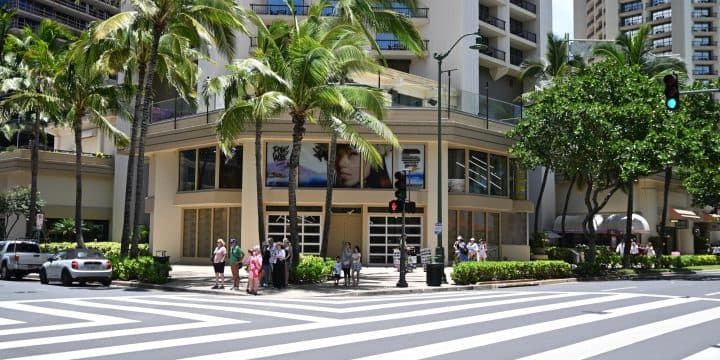
Beyond murals, Hadar has extended his vision into other ventures. Kings & Queens, a retail space in the heart of Waikīkī, is both a gallery and a boutique, the exclusive home of the Kamea Brand. Located across from the Duke Kahanamoku statue, it merges commercial appeal with cultural storytelling. The space offers Hawaiian-inspired lifestyle brands and collaborations with local artisans, and displays Hadar’s artwork on apparel, allowing visitors to carry a piece of Honolulu home. Hadar describes it as a way to honor the past — the royalty, the surf culture, the spirit of aloha — while engaging with the present in a way that feels genuine, not like the tropical Disneyland that so much of Waikīkī is.
“Waikīkī is, for me, one of the final frontiers, because we’re not allowed to paint murals there,” says Hadar about the vision behind Kings & Queens. “It’s trying to spread art in any way you can, right? So, if you won’t let me paint a big building, then I’ll try to find ways to spread art in another way.”
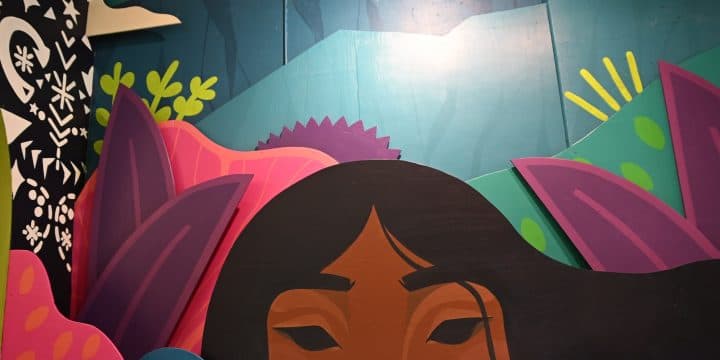
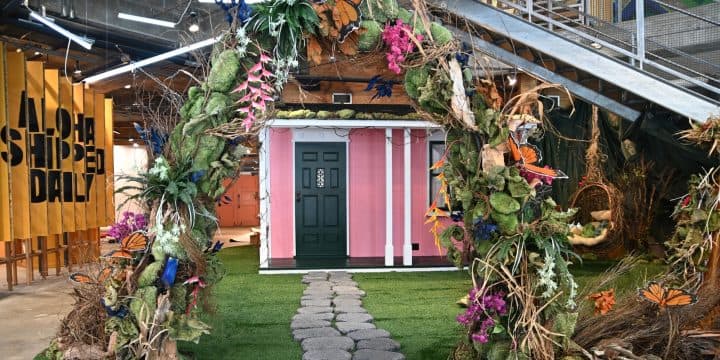
His other Waikīkī project, the latest immersive exhibition at 2424 Kalākaua Avenue within the Hyatt Regency Waikīkī Beach Resort and Spa, extends this philosophy. “In The Southern Sun” reimagines Waikīkī through art, memory, and multi-sensory design. Guests move through four seasonal chapters — golden dawn to indigo dusk — following the Hawaiian proverb “Mai ka lā hiki a ka lā kau” (“From sunrise to sunset”). Murals, installations, and sensory work by a range of artists invite visitors to explore the layered past of Waikīkī and connect with the land and its stories. Here, Hadar’s role is that of curator as much as artist, shaping a self-guided experience that is as much about personal reflection as about aesthetics.
Today, Hadar’s legacy and reach extend far beyond his own brushes. He now connects creators with opportunities, cultivates mentorship networks, and ensures that Hawai‘i’s visual storytelling continues to thrive. He is invested in the future of art in Hawai‘i, not just in murals or exhibitions, but in fostering a community where artists can flourish, stories can be shared authentically, and cultural heritage is honored. This duality of seasoned businessman-meets-hands-on artist characterizes the diversity of the work he does, work that may have started with murals in Kaka‘ako a decade ago but now extends to facilitator, connector, and guide. However, his love for painting, scale, drama, narrative, and this place remains undiminished.
“I'm incredibly proud of Hawai‘i and where I’m from, and being in a small place like Hawai‘i, you grow up getting ahead by collectively helping each other. When you help your peers, it’s like the metaphor of the rising tide lifts all boats versus growing up in a place that’s a little bit more cutthroat,” Hadar explains. “So, artists, we try to support each other instead of thinking, ‘Well, I’d better destroy my competition before they get more.’ Because I don’t believe it’s a limited resource, where there’s only a certain amount of pieces to the pie. I believe that you could grow the pie as much as you need.”
In the end, Hadar’s work is a conversation with time. Through wildlife studies in Kaka‘ako, inspiring portraits of icons, or collaborations with modern creatives, he weaves together threads of past and present, always working to ensure that the next generation of artists can write the next chapter. Honolulu is a city of constant motion, of history layered over surf shops and hotels, and Kamea Hadar is both witness and author, recording its stories in pigment, space, and light.
To walk past one of his murals is to see the city differently. To step into Kings & Queens or “In The Southern Sun” is to engage with the heartbeat of Honolulu and the promise of its future. And to understand Kamea Hadar is to understand that art is never static. It moves, soars, guides, and elevates, just like the ‘iwa itself, reminding every passerby that this place, these stories, and these people are home.
kameahadar.com
Kings & Queens; Located in the Hyatt Regency Waikiki Beach Resort and Spa, 2424 Kalākaua Ave, Honolulu; (808) 200-5830; Open daily from 9 a.m. to 10 p.m.; Follow on Instagram @kingsandqueens_hawaii.