


©2023 Savvy360, LLC. All Rights Reserved
PLAN A TRIP IN OUR APP


Elyse Butler

Elyse Butler

Elyse Butler
Elyse Butler

Elyse Butler

Elyse Butler
Main Characters
The Wonderful, Whimsical World of Kris Goto
BY Natalie Schack
If you’ve seen a Kris Goto piece, you remember it. There’s something unforgettable about the dreaminess of it, the whimsy, the magical realism. There’s an almost eerie element to her dreamscape pen-and-ink creations, but also an almost childlike wonder. You’ll find moments of explosive joyfulness, but also the calm quietude of an otherworldly serenity. Among them all, though, is a shared inscrutability, a mystery. After all, Goto doesn’t want to tell people what her artwork means.
In fact, she’d rather they decide for themselves.
The Honolulu-based artist intentionally keeps many of her titles open to interpretation, inviting viewers to bring their own experiences to each piece instead of searching for a “correct” answer. It’s a philosophy that runs through everything she creates, from her intricate drawings to the large-scale murals you’ll find splashed across walls in Hawai‘i and beyond.
To Goto, her role is simply to inspire. The viewer takes it the rest of the way.
In one piece, two bikini-clad figures disappear into a giant Spam musubi, massive grains of rice tumbling around their legs as their heads vanish beneath an oversized slab of Spam wrapped in nori. Are they slipping into another dimension? Diving headfirst into the comfort of a favorite local snack? Indulging in the ultimate kanak attack?
In another, divers in full wetsuits and snorkeling gear are tucked among a sprawling field of brilliant green kalo (taro) leaves, like tiny Waldos hidden in a Hawaiian-themed I Spy. Are they searching for the beach? Looking for one another after getting lost among the winding rows? Or are they simply exploring another fantastical world that exists only within Goto’s imagination?
The questions are, of course, part of the experience. Goto isn’t interested in providing definitive answers. Instead, she creates space for viewers to become participants, allowing curiosity and imagination to complete each work in deeply personal ways. That openness isn’t just about the finished artwork. It’s also the guiding principle behind Goto’s own creative journey, shaped by curiosity and self-belief. Born in Kagoshima, Japan, Goto spent her childhood in Hong Kong before moving to New Zealand and eventually settling in Hawai‘i in 2006. Growing up across cultures gave her an expansive visual vocabulary, though art itself was always the constant.
Her belief that creativity can’t be defined by someone else took root early. She still remembers receiving criticism from a teacher who complained that Goto had displayed a lack of creativity in her assignment.
Goto challenged the comment, questioning who had the authority to decide what did or didn’t qualify as creativity. The experience reinforced a belief she still holds today: creativity isn’t a paradigm another person gets to define.
The exchange stayed with her. Years later, it has become a belief she hopes to pass on to other artists: trust your own instincts. While technical skills can be taught, originality comes from giving yourself permission to create without constantly seeking validation.
Drawing wasn’t simply a hobby; it was how she naturally understood the world, a practice that continued into adulthood. And for years, Goto balanced art with a traditional job while selling work at local art fairs. Then, in 2017, she made the leap and became a full-time artist. The transition wasn’t sparked by a dramatic breakthrough but by an unexpected conversation.
Someone pointed out that she wasn’t treating her own artwork as something valuable. She was giving it away, treating it lightly, as if she didn’t fully appreciate what she had created.
The comment forced her to rethink her relationship with her work. If she wanted others to see her art as meaningful, she realized she had to start treating it that way herself. She became more intentional, building her brand, reaching out to galleries and businesses, and actively pursuing opportunities instead of waiting for them to appear.
That decision transformed not only her career but also the scale of her work. Today, her murals appear throughout Hawai‘i and internationally, while collaborations with businesses and community organizations have introduced her playful visual language to audiences far beyond the gallery.
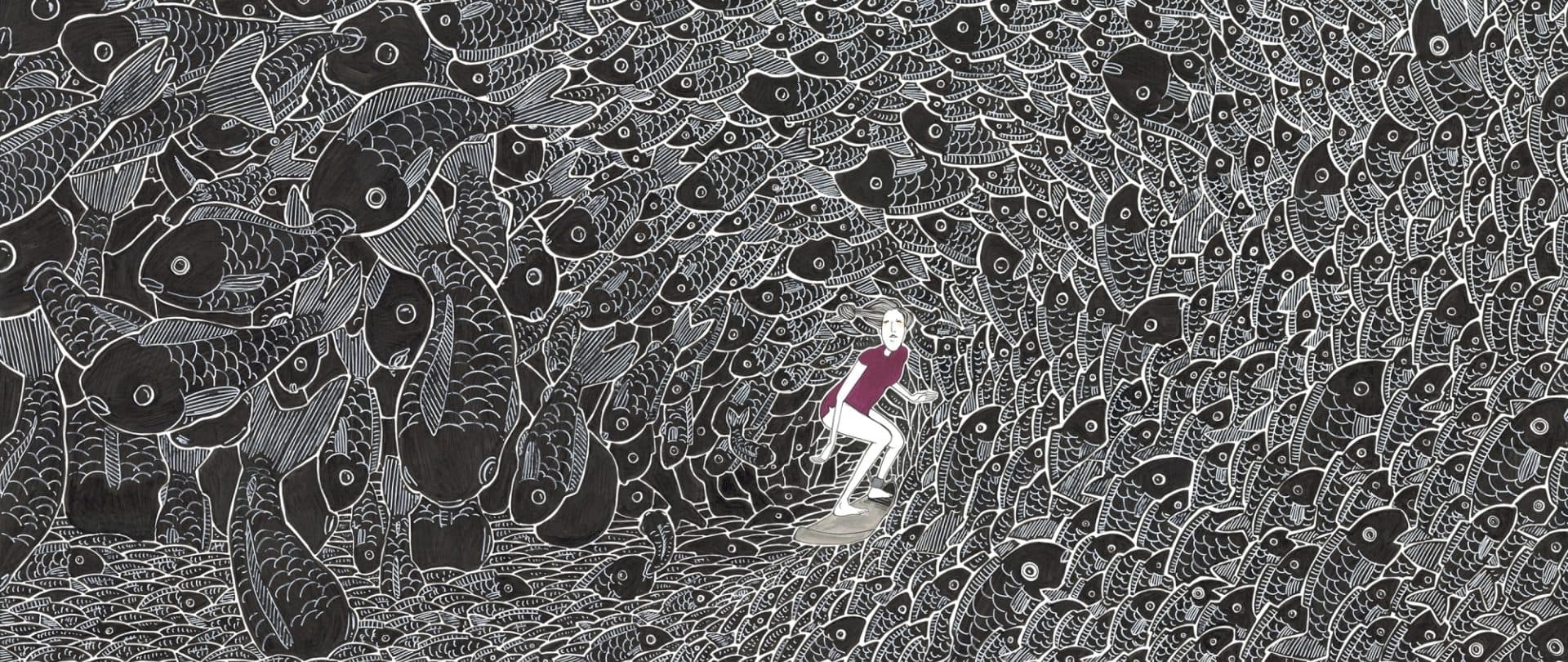
And her artistic style has evolved alongside her life. Early pieces often reflected her love of surfing and, as she says, a more “emo” aesthetic, frequently rendered in black and white with tightly framed female figures at their center. They possessed a quieter, more introspective mood.
Over time, however, Hawai‘i itself began finding its way into the work.
As a child, Goto dreamed of becoming a manga artist, and traces of that influence remain visible throughout her work today. It isn’t simply the meticulous black-and-white linework or the stylized figures that recall manga, but the way she constructs visual narratives. She often refers to her subjects as “main characters,” approaching paintings less as isolated images than as moments within a larger story waiting to unfold.
That storytelling instinct is perhaps most evident in A Place You Can Find Your Own Rainbow (2026), a series that follows a young woman named Eve as she journeys across Hawai‘i searching for “her rainbow,” only to discover that what allowed her to belong had been within her all along. It’s a gentle meditation on belonging and self-discovery, a reminder that the things we spend our lives searching for are sometimes already part of us.
The longer Goto lived in the islands, the more color crept onto the page. Tropical plants, oversized fruit, schools of fish, and rolling waves expanded beyond decorative details to become the subjects themselves. Rather than isolating a central character, many newer works immerse people within lush environments that celebrate the richness of island life.
The message feels especially fitting coming from Goto herself. Just as Eve discovers the rainbow was never something to be found elsewhere, Goto’s own artistic journey has been about rediscovering the creative confidence she believes children possess naturally before self-doubt takes hold.
The shift mirrors changing priorities. While surfing once inspired much of her work, her attention has increasingly turned toward the environment surrounding it: the landscapes, plants, and ocean ecosystems that shape everyday life in Hawai‘i.
Her work still carries the playful surrealism that has become her signature. Fish swim through unexpected spaces. Umbrellas drift across impossible scenes. Familiar objects appear enlarged or slightly transformed, bending reality just enough to encourage viewers to pause and look again. There’s often an undercurrent of mystery, but never heaviness. Instead, the work balances whimsy with detail, inviting wonder without insisting on a single interpretation.
That sense of possibility is exactly what Goto hopes audiences leave with.
Just as she doesn’t want viewers searching for one definitive meaning in her paintings, she doesn’t want emerging artists believing there’s only one correct way to create.
She knows how easy it is for confidence to erode over time, to begin questioning instincts that once felt effortless. Her own career has become evidence that creative growth often comes not from finding answers but from becoming comfortable with uncertainty.
Today, Goto’s murals and illustrations continue to transform ordinary walls and everyday objects into dreamlike worlds filled with movement, color, and quiet humor. Interwoven throughout the intricate lines, vibrant patterns, and surreal imagery is an invitation to play: to pause, look closer, and discover something uniquely your own. In many ways, her work encourages viewers to reconnect with the sense of wonder and creative confidence that comes so naturally in childhood.
For Goto, that freedom may be the most creative act of all. Perhaps that’s why her paintings linger long after you’ve walked away — not because they offer answers, but because they remind us what it feels like to imagine without needing permission.